
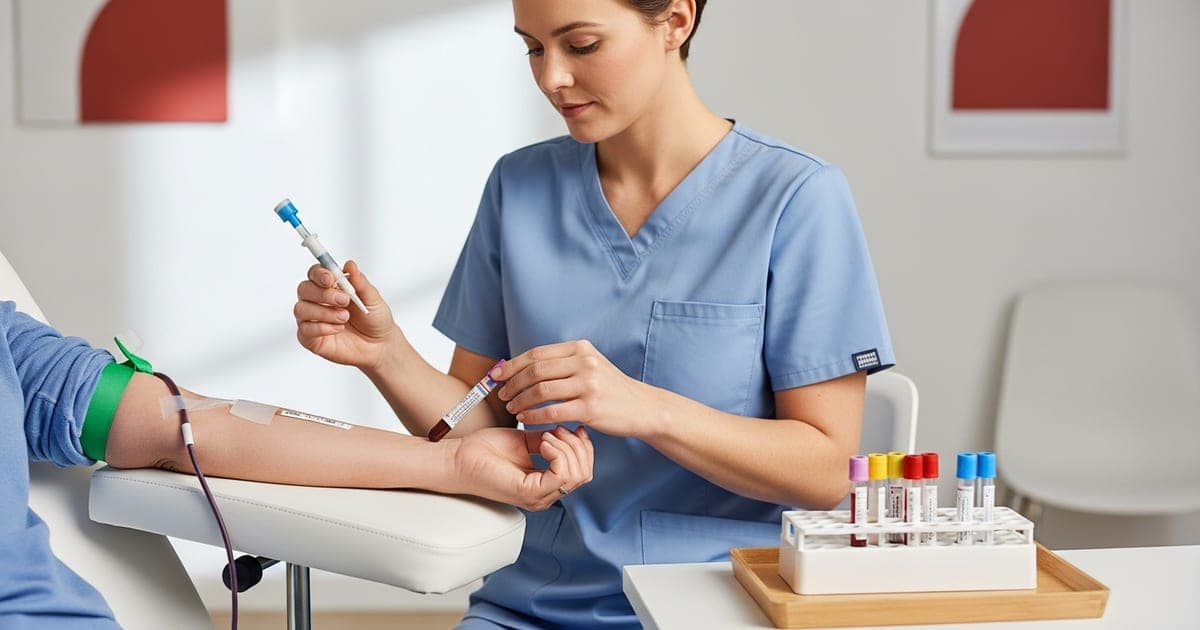
Quest Diagnostics and LabCorp operate the two largest patient service center (PSC) networks in the United States. Together they process hundreds of millions of specimens a year and are the default choice for most outpatient lab orders. Mobile phlebotomy — where a certified phlebotomist comes to you — uses the same labs, the same tubes, and the same reference ranges. The difference is entirely in who moves: the patient or the collector.
If you have been directed to a Quest or LabCorp draw site and are weighing whether an at-home mobile draw is worth it, here is a direct comparison across the dimensions that actually matter.
Cost: what you actually pay with each option
Both options have two cost components: the collection fee and the lab processing fee. The lab processing fee — what the reference lab charges for running the actual tests — is identical whether you walk into a PSC or have a mobile phlebotomist collect at home. Your insurance applies the same way in both cases.
The collection fee is where the difference lies:
| Option | Collection Fee | Lab Processing Fee | Total Patient Cost |
|---|---|---|---|
| Quest Diagnostics PSC | Typically waived with insurance | Billed to insurance by Quest | Insurance copay / deductible only |
| LabCorp PSC | Typically waived with insurance | Billed to insurance by LabCorp | Insurance copay / deductible only |
| Speedy Sticks (mobile) | $150 service fee (out-of-pocket) | Billed to insurance by Quest or LabCorp — same as PSC visit | $150 + insurance copay / deductible |
The $150 Speedy Sticks service fee covers the phlebotomist's travel and collection — it is not currently billable to commercial insurance. The downstream lab processing fees are identical to a PSC visit because the specimen goes to the same lab and is billed the same way.
When the math works in mobile's favor: For patients who would otherwise spend 2–3 hours traveling, waiting, and returning — particularly for early-morning fasting draws — the $150 is often a straightforward trade against time. For patients who need to pay for transportation, take time off work, or arrange childcare or elder care for a clinic visit, the economics shift further toward mobile.
Convenience and scheduling
| Factor | Quest / LabCorp PSC | Mobile Phlebotomy |
|---|---|---|
| Location | Travel to a PSC required; availability varies by area | Phlebotomist comes to your home, office, or facility |
| Appointment windows | Typically 7 AM–5 PM weekdays; some Saturday hours | Early morning, evening, and weekend windows available |
| Wait time | Walk-in: 15–60+ min; scheduled: 5–20 min | Phlebotomist arrives at your booked window; no waiting room |
| Fasting draw logistics | Must drive while fasted; eat only after returning home | Draw happens at home before eating or driving anywhere |
| Pediatric draws | Child must travel; clinic environment can increase anxiety | Draw at home in a familiar, calm environment |
| Mobility-limited patients | Requires transport, which may not be available | No transport needed at all |
Specimen quality and collection standards
The assumption that an at-home draw is somehow lower quality than a clinic draw is incorrect — the quality is identical when performed by a nationally certified phlebotomist following standardized protocols.
Every Speedy Sticks phlebotomist is nationally certified (ASCP, AMT, or NHA) and follows the same venipuncture standards used at any PSC:
- Same tube types, fill order, and anticoagulant requirements for each test ordered
- Tubes labeled at the patient's bedside, not after leaving the room
- Chain-of-custody documented from first stick to laboratory receipt
- Specimens routed to Quest, LabCorp, or your specialty lab per their temperature and transport requirements
- Same reference ranges — your results are processed and reported by the same laboratory
The only meaningful difference is the transport leg: mobile-collected specimens travel from your location to the lab rather than from a PSC. Speedy Sticks uses the same transport protocols and temperature management that PSCs use for their courier pickups — because that is how PSC specimens travel after collection anyway.
Which lab receives and processes your specimen?
Your specimen is routed to whichever lab your physician specified on the order — Quest Diagnostics, LabCorp, or a specialty reference lab. If your physician sent the requisition to Quest, your mobile-collected specimen goes to Quest. The reference ranges, result reporting, and your physician's portal integration are all unchanged.
You are not getting a different lab or different test methodology. You are getting the same lab with a different collection pathway.
When a PSC is the better choice
- The service fee does not make sense for your situation — if you live 5 minutes from a PSC with good availability and no scheduling friction, the PSC wins on cost.
- You need a same-day STAT result — PSCs can sometimes prioritize urgent processing; mobile scheduling may not accommodate very short notice draws.
- Your test requires immediate on-site processing — a small number of tests require immediate centrifugation or special handling that is incompatible with transport. Confirm with your physician if you have concerns about a specific test.
- Observed collection is required — DOT drug testing and certain legally mandated collections must be performed at a certified site under direct observation. Mobile phlebotomy cannot substitute for these.
When mobile phlebotomy is the better choice
- Fasting morning draws where you would otherwise drive before eating
- Pediatric draws — children typically do better in a familiar home environment
- Elderly or mobility-limited patients for whom transport is difficult or impossible
- Patients with needle anxiety who are calmer at home than in a clinical setting
- Recurring monitoring draws (INR, HbA1c, drug levels) where cumulative time savings are significant
- Homebound patients, assisted living residents, or patients in post-acute recovery
- Professionals who cannot take 2+ hours out of a workday for a PSC visit
- Caregivers coordinating lab schedules for family members with complex conditions
How to switch from a PSC to a mobile draw
If you have a standing lab order for Quest or LabCorp, you do not need a new order to switch to mobile collection. The process:
- Book your Speedy Sticks appointment online and specify which lab your order is directed to
- Have your lab order number or requisition available at the time of the draw
- Your phlebotomist arrives, collects, and routes the specimen to the designated lab
- Results appear in the same portal they always do — your provider's system or the Quest or LabCorp patient portal
No new referral, no re-ordering. The only thing that changes is where the collection happens.
Need blood drawn at home?
Speedy Sticks sends a certified phlebotomist to your door — no clinic visit required. Book online with your lab order.
Book a Mobile Blood Draw →