
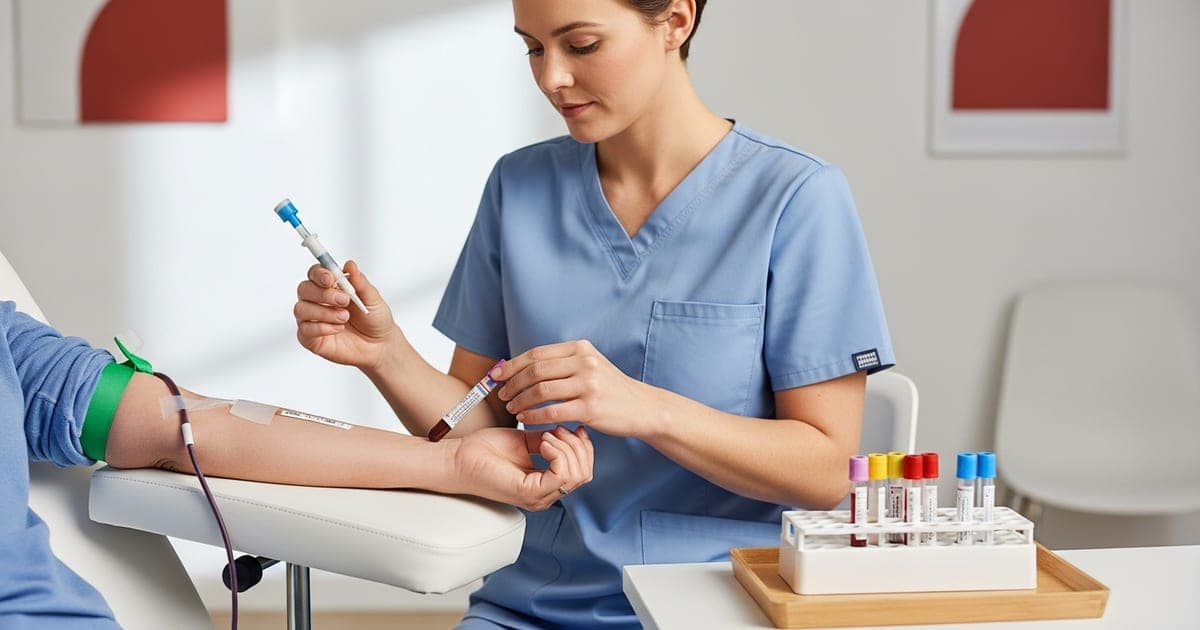
A mobile phlebotomist performs the same blood collection work as a clinic-based phlebotomist — the difference is that they travel to the patient instead of waiting for the patient to travel to them. Understanding exactly what that role involves helps patients know what to expect, and helps anyone evaluating a mobile phlebotomy service know what to look for.
Core responsibilities of a mobile phlebotomist
The job has four distinct phases for each patient visit:
Pre-visit preparation
Before arriving at your door, a mobile phlebotomist reviews your order to confirm which tubes are required, what fill volume and order of draw is needed, whether any special handling is required (cold-chain, light-sensitive tubes, room temperature vs. refrigerated transport), and whether any concurrent tests need different routing than the primary draw.
They pack the correct supplies: the right tube types and quantities, appropriate needles (gauge varies by patient and tube type), tourniquet, alcohol swabs, gauze, bandages, specimen labels pre-printed with patient identifiers, and the appropriate transport packaging for temperature-sensitive specimens.
Patient identification and order verification
At bedside, before any needle is uncapped, a mobile phlebotomist confirms the patient's identity using two identifiers — typically name and date of birth, compared against the lab order. This is a non-negotiable safety step: mislabeled specimens lead to wrong results, wrong results lead to wrong treatment decisions.
They verify the order against what they prepared, confirm any fasting status or preparation requirements are met, and review any patient-reported allergies or conditions that affect collection site selection.
Blood collection
The draw itself uses standard venipuncture technique — needle insertion into a peripheral vein, typically the antecubital fossa (inside of the elbow), though forearm, wrist, and hand sites are used when necessary. The mobile phlebotomist:
- Selects the appropriate site based on vein quality, patient preference, and order requirements
- Applies a tourniquet to distend the vein for easier access
- Cleans the site with 70% isopropyl alcohol and allows it to dry completely before insertion
- Inserts the needle at the correct angle and confirms blood return before filling tubes
- Fills tubes in the correct order of draw (blood culture bottles first if ordered, then citrate tubes, then serum, then heparin, then EDTA, then fluoride — to prevent anticoagulant carryover between tubes)
- Inverts additive tubes the correct number of times to mix the anticoagulant without causing hemolysis
- Withdraws the needle and applies pressure to stop bleeding
Specimen handling and transport
After the draw, tubes are labeled at the patient's side — never later, never in the car. Each label includes the patient's name, date of birth, collection date and time, and the collecting phlebotomist's identifier. This is the bedside labeling standard that clinical laboratories require for specimen acceptance.
The mobile phlebotomist documents the collection — time, site, volume, any deviations from the order — and packages specimens for transport. Temperature-sensitive specimens go into appropriate cold-chain packaging. Chain-of-custody documentation travels with the specimen to the reference lab.
What certification does a mobile phlebotomist need?
Three national certification bodies are recognized by clinical laboratories and healthcare facilities:
- ASCP (American Society for Clinical Pathology) — the PBT(ASCP) or CPT(ASCP) credential; widely considered the most rigorous and most recognized by hospital laboratories
- AMT (American Medical Technologists) — the RPT credential; equivalent recognition in most clinical settings
- NHA (National Healthcareer Association) — the CPT credential; accepted by most clinical laboratories and required by many employer-based phlebotomy programs
All three require completion of a formal phlebotomy training program and passing a written examination. Continuing education is required to maintain certification — meaning a certified phlebotomist is not just trained once, but keeps current with evolving standards.
Mobile phlebotomists need additional competency beyond the basic certification: specimen transport logistics, cold-chain management, documentation requirements for chain-of-custody, and familiarity with the specific requirements of major reference labs (Quest, LabCorp) and any specialty labs they route to. Speedy Sticks phlebotomists are nationally certified and trained to these additional mobile-specific standards.
How is a mobile phlebotomist different from a clinic phlebotomist?
The clinical skill set is identical — the venipuncture technique, tube selection, order of draw, and specimen handling standards are the same. The differences are operational:
- Transport — a mobile phlebotomist handles specimen transport from the collection site to the lab, which requires training in packaging, cold-chain, and chain-of-custody continuity
- Environment variability — clinic phlebotomists draw in a controlled environment with a phlebotomy chair, good lighting, and immediate supervisor access; mobile phlebotomists draw at kitchen tables, bedsides, and offices, adapting to the environment they find
- Independent judgment — without immediate supervisory backup, a mobile phlebotomist must independently manage difficult vein situations, patient vasovagal reactions, and order discrepancies without escalating to a supervisor on-site
- Communication — mobile phlebotomists interact directly with patients and caregivers without front-desk or nursing staff to mediate, which requires clear patient communication skills on specimen requirements, preparation, and results routing
What happens if a mobile phlebotomist can't find a vein?
Difficult venous access is one of the most common challenges in phlebotomy, and mobile phlebotomists are trained to manage it. Standard escalation steps:
- Site change — if one arm is difficult, switch to the other; if antecubital access is poor, try the forearm or hand
- Warming — a warm compress applied for 2–3 minutes can dilate superficial veins enough to access them
- Position change — having the patient lower their arm, clench and release their fist, or adjust chair height can improve vein prominence
- Two-attempt limit — most facilities and mobile services follow a policy of no more than two venipuncture attempts per phlebotomist per visit; if access is not achieved in two attempts, the visit is documented and rescheduled with additional support
Speedy Sticks also offers a difficult vein blood draw service for patients with consistently challenging venous access — paired with phlebotomists experienced in working with pediatric, oncology, and elderly patients who present with difficult veins.
What orders can a mobile phlebotomist fill?
Any standard blood draw order that a patient service center can fill. This includes:
- Routine panels: CBC, CMP, BMP, lipid panel, thyroid function, liver function, HbA1c, vitamin levels
- Specialty panels: hormone panels, autoimmune markers, coagulation studies (INR/PT/PTT), therapeutic drug monitoring
- Fasting draws: glucose, lipids, iron studies, and any panel requiring pre-draw fasting
- Therapeutic phlebotomy: high-volume draws for hemochromatosis, polycythemia vera, or related conditions (under physician order)
- Specialty lab kits: collection into kits for specialty labs like Genova, DUTCH, ZRT, or Cleveland HeartLab (when the kit requires a blood draw rather than a self-collection format)
Orders that require direct observation (DOT drug testing, some forensic collections) cannot be completed by a mobile phlebotomist. Confirm with your provider if your order has any special collection site requirements.
Need blood drawn at home?
Speedy Sticks sends a certified phlebotomist to your door — no clinic visit required. Book online with your lab order.
Book a Mobile Blood Draw →