
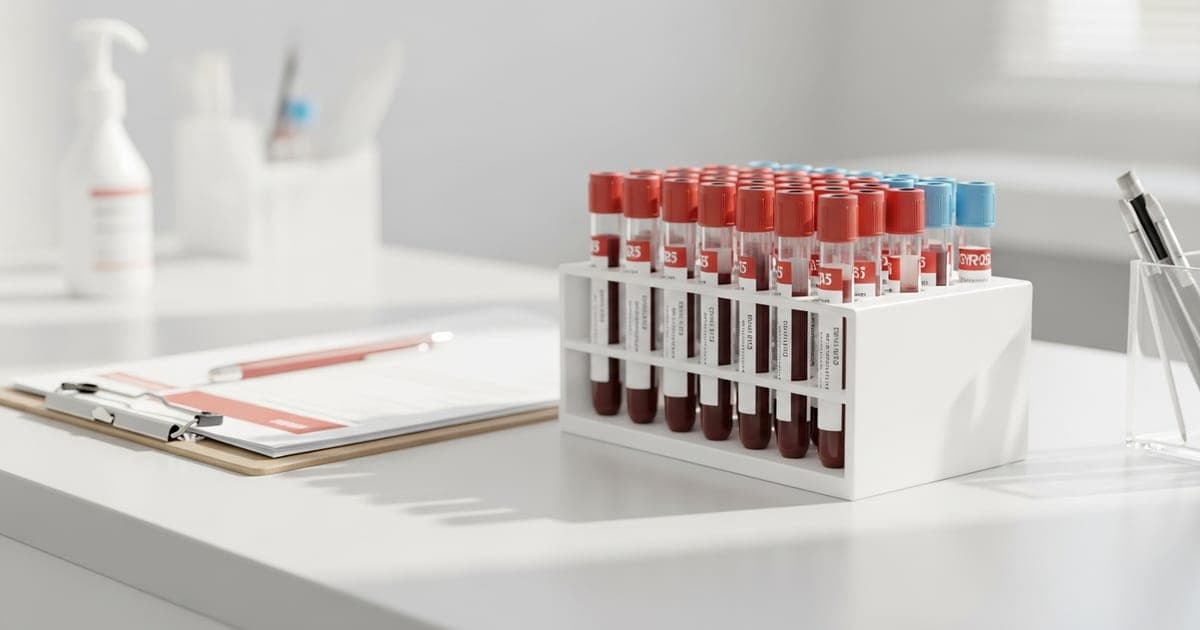
A typical blood draw takes between 1 and 10 vials, and even drawing 10 to 12 vials removes less blood than a single standard blood donation — roughly 2–3% of the average adult's total blood volume. The number of tubes your phlebotomist draws has nothing to do with a limit on what is safe. It reflects how many tests your doctor ordered and which tube types each test requires.
How Much Blood Is in Your Body?
The average healthy adult has approximately 4.7 to 5.5 liters (about 10–12 pints) of blood. Body weight and sex influence this: men tend to have slightly more blood volume than women of the same weight. Your body regulates blood volume tightly — it replaces plasma within 24–48 hours of any significant draw and fully replaces red blood cells within 4–6 weeks.
How Much Blood Fits in a Vial?
The small tubes used in blood draws — called vacutainers or evacuated collection tubes — hold varying amounts depending on their size:
- Standard adult tube (3–10 mL): most common size, typically 5–8.5 mL of blood
- Pediatric/small tube (1.8–3 mL): used for children or difficult-access patients
- Large tube (10 mL): used for some culture and special chemistry tests
A typical 10-tube adult draw collects roughly 50–80 mL of blood total — about 3–5 tablespoons, or 1–2% of your total blood volume. For context, the Red Cross collects approximately 450–500 mL (1 pint) in a single whole blood donation — six to ten times more.
How Many Vials Does Each Test Require?
The number of vials depends on what is being tested and which tube additive the test requires. Different tests need different tube types because some are chemically incompatible with the same tube.
- Basic metabolic panel (BMP): 1 tube, ~5–8 mL
- Comprehensive metabolic panel (CMP): 1–2 tubes, ~8–15 mL
- Complete blood count (CBC): 1 lavender-top tube, ~3–5 mL
- Lipid panel: 1 tube, ~5–8 mL
- Thyroid panel (TSH + T3/T4): 1–2 tubes, ~5–15 mL
- HbA1c: 1 tube, ~3 mL
- Coagulation / INR (PT/PTT): 1 blue-top tube, ~2.7 mL
- Annual wellness (CBC + CMP + lipids + thyroid): 4–6 tubes, ~25–50 mL
- Comprehensive specialty workup: 8–15 tubes, ~50–100 mL
Why Are So Many Tubes Used for One Draw?
Each colored-top tube contains a specific additive: red/gold (SST) for serum chemistry, lavender (EDTA) for CBC and HbA1c, light blue (citrate) for coagulation tests, green (heparin) for stat chemistry, and gray (fluoride/oxalate) for glucose and lactic acid. A test that requires serum cannot be run from an EDTA tube, and vice versa. This is why even a simple annual panel often needs 4–6 tubes — the tests are chemically incompatible in the same container.
Is Drawing 10 or More Vials Safe?
For a healthy adult, yes. Ten to fifteen vials removes 50–100 mL of blood — a small fraction of total blood volume. Your body begins replenishing plasma almost immediately and fully restores red blood cell mass within weeks. There is no medical basis for concern in an otherwise healthy adult.
Volume matters more in these situations:
- Existing anemia — your doctor may order fewer draws or space them out
- Small body size or low weight — blood volume scales with body size
- Frequent repeated daily draws — monitored in ICU settings to prevent "phlebotomy anemia"
- Neonates and premature infants — draws are carefully volume-limited
Why Does It Feel Like More Blood Than It Is?
Watching several tubes fill up on a tray looks dramatic, but perspective helps: a standard dinner glass holds about 250 mL. Even a 12-tube draw fills less than half that glass. The visual is far more alarming than the actual volume removed.
Tips to Feel Better After a Multi-Tube Draw
Mild soreness at the draw site is normal. If you notice significant swelling, warmth, or redness around the vein, it could be a sign of phlebitis or infiltration — two IV complications worth knowing how to tell apart.
- Stay hydrated: drink a full glass of water before your appointment — hydration makes veins easier to access and speeds plasma replacement afterward
- Eat beforehand (unless fasting for the test): having food in your system prevents dizziness
- Sit for 5–10 minutes after the draw before standing up
- Snack after: juice, crackers, or any light snack helps your body stabilize quickly
Skip the Clinic — Get Your Draw Done at Home
Whether you need 1 tube or 12, Speedy Sticks mobile phlebotomy brings a certified phlebotomist directly to your home or office. We handle all standard tube types and work with every major lab. Book your visit now. Parents looking to simplify a multi-tube draw for a child can also schedule a pediatric blood draw at home — no waiting room, no clinic trip. If your order includes an annual wellness panel, our wellness blood draw service covers the full standard workup from your own home.
This content is for informational purposes only and is not a substitute for professional medical advice.
Sources and further reading
Maximum blood draw limits by patient population
The total volume of blood that can be safely drawn in a single session varies by patient:
| Population | Max single draw (general guidance) | Notes |
|---|---|---|
| Healthy adult | 450–500 mL (1 unit) — research phlebotomy; routine draws far less | Routine labs use 3–40 mL total across all tubes |
| Standard outpatient adult | 30–60 mL per session | Covers most comprehensive panels (8–12 tubes) |
| Pediatric (child) | 5–10% of blood volume; typically 1–15 mL | Volume strictly limited relative to body size |
| Infant / neonate | 1–2.5% of blood volume; often <5 mL | Requires pediatric-experienced phlebotomist |
| Elderly or anemic | Reduced from standard adult limits | More frequent monitoring of hemoglobin if repeated draws |
Why your labs might require more or fewer tubes than expected
The number of tubes drawn reflects the tests ordered, not how much blood is needed for each individual test. Several factors affect tube count:
- Tube type incompatibility: CBC requires an EDTA tube (purple); chemistry panels require a serum separator tube (gold/red); coagulation tests require a citrate tube (blue); each is separate and cannot be combined
- Order of draw: CLSI guidelines specify the sequence in which tube types must be filled to prevent cross-contamination of additives between tubes — this is why a phlebotomist draws them in a specific order regardless of test priority
- Overfill requirements: some tubes (especially coagulation tubes) must be filled to exactly the manufacturer's specified volume for the anticoagulant-to-blood ratio to be correct. Short-fills invalidate the coagulation result.
- Hold tubes: labs often request one or two "hold" tubes — extra serum or plasma that is stored briefly in case add-on tests are needed after the initial results are reviewed
One Visit, Full Workup — at Home
Multiple panels can be drawn in a single mobile phlebotomy visit. A certified phlebotomist comes to you with the right tubes in the right draw order — efficient, compliant, same lab.
Book a visit →