
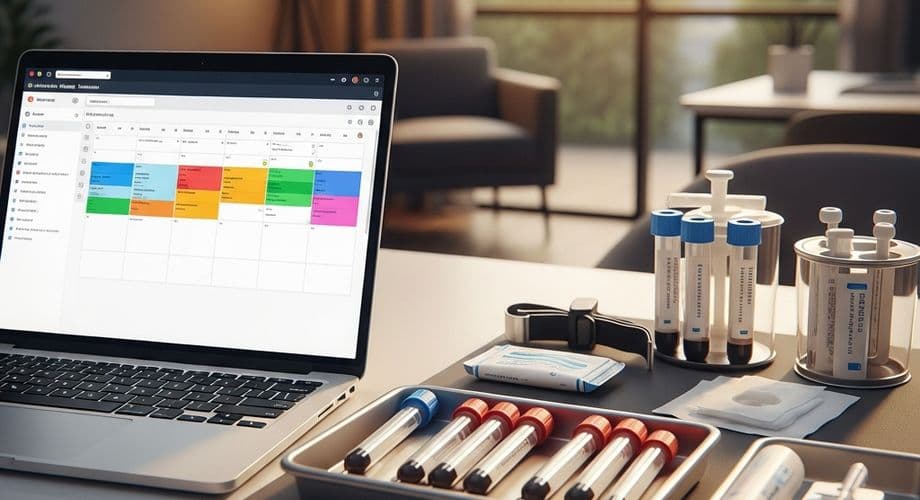
Every platform that touches lab testing eventually hits the same wall: the blood draw itself. A telehealth company can prescribe a panel, an EMR can generate a requisition, a benefits platform can enroll an employee in a wellness program — but somewhere a phlebotomist still has to physically collect the specimen. For years, that step meant a phone call, a fax, or a manual handoff to a courier network. A mobile phlebotomy API replaces that handoff with a direct integration: your platform sends a structured request, and scheduling, order intake, and status updates happen programmatically.
This guide covers what a mobile phlebotomy API actually does, who uses one, and how to evaluate whether API integration or manual coordination is the right fit for your organization.
What is a mobile phlebotomy API?
A mobile phlebotomy API is a programmatic interface that lets an external platform request an at-home or on-site blood draw without a human coordinating each visit by phone or email. Instead of a support team manually entering patient details into a booking form, your platform's own software calls the API directly — the same way it might call a payment processor or a shipping carrier.
At a functional level, a mobile phlebotomy API typically supports:
- Scheduling — requesting an available phlebotomist visit window at a given address, and receiving confirmation once a certified phlebotomist accepts the visit
- Order intake — submitting the lab requisition or test panel associated with the visit, including routing instructions for the destination lab (Quest, Labcorp, or a specialty lab)
- Status updates — receiving updates as the visit moves from scheduled to completed, including specimen collection confirmation and any exceptions (no-show, redraw needed, access issue)
The API sits underneath the same operational network that powers a standard mobile phlebotomy visit — certified phlebotomists, standard venipuncture technique, and routing to any US-licensed reference lab. The difference is that a platform's own software triggers each step instead of a person doing it manually.
Why platforms integrate instead of coordinating manually
Manual coordination works fine at low volume — a handful of bookings a month can go through a contact form or a phone call. It breaks down once a platform crosses a volume threshold where every booking still requires a human to relay information back and forth. Three patterns show up consistently in organizations that move to an API integration:
- Volume. A telehealth platform sending dozens or hundreds of draw requests per week can't have a staff member re-typing patient information into a separate booking system for every order. An API call replaces that re-entry.
- Native scheduling experience. Benefits platforms and EMRs often want the blood draw to feel like a native feature of their own product — the patient books inside the platform's existing app or portal, not a separate third-party site. An API lets the scheduling UI stay inside your platform while the phlebotomy network runs behind the scenes.
- Status visibility. Clinical trial sponsors and hospital systems frequently need to know the state of every visit — scheduled, completed, exception — inside their own systems for compliance and monitoring, not in a separate inbox.
Organizations below that threshold are usually better served by a standard B2B account with manual or semi-automated coordination — API integration adds engineering overhead that only pays off once volume or product requirements justify it.
Who typically integrates with a mobile phlebotomy API
Telehealth and direct-to-consumer platforms
Telehealth companies that order labs as part of a consult flow can trigger a draw request the moment a provider signs off on an order, rather than sending the patient to a separate booking page. This keeps the patient inside a single product experience from consult to results.
EMR and health system integrations
Health systems and EMR platforms with high-volume home health or outreach programs can connect scheduling and status updates directly, rather than manually processing individual requisitions. See our hospital and health system page for how this fits into broader outreach and discharge workflows.
Employer wellness and benefits platforms
Benefits platforms running annual biometric screening programs for distributed workforces can let employees book a home draw from inside their existing wellness app, with the scheduling and lab routing handled through the API instead of a separate vendor portal. Details on the program side are covered on our employer wellness page.
Clinical trial and CRO systems
Decentralized and hybrid clinical trials frequently need scheduling and visit-status data flowing into a sponsor's or CRO's existing trial management system rather than a separate spreadsheet. An API integration keeps protocol-driven visit windows and completion status synchronized with the trial's system of record — see our CRO and sponsor page for the broader decentralized trial context.
What integration typically looks like
A mobile phlebotomy API integration generally follows the same shape regardless of industry:
- Scoping — the partnerships team reviews expected volume, geographic footprint, and the specific workflow (patient-facing booking, internal ops tool, or backend automation only)
- Access and credentials — API access is provisioned for the integration
- Order and scheduling calls — the platform submits visit requests with patient/location details and the associated lab order
- Status handling — the platform consumes status updates to reflect visit state inside its own product or ops dashboard
- Go-live and monitoring — visits run through the standard phlebotomist network with all 50 states in scope, and the integration is monitored during initial rollout
Because visits still run through the same certified phlebotomist network used for every Speedy Sticks draw — ASCP, AMT, or NHA certified — API-triggered visits use identical collection standards and lab routing to a visit booked through the standard consumer flow. The API changes how a visit is requested and tracked; it does not change how the draw itself is performed.
Evaluating build vs. integrate
Platforms sometimes ask whether they should build their own phlebotomist network rather than integrate with an existing one. In practice, recruiting, credentialing, and coordinating certified phlebotomists across even a handful of states is a significant standalone operation — before accounting for lab relationships, supply logistics, and chain-of-custody handling. Integrating with an existing nationwide network through an API gets a platform to the same functional outcome — a patient gets a blood draw, the specimen reaches the right lab, results come back — without building phlebotomy operations from scratch.
Getting started
API access is scoped per partner based on volume and workflow — it isn't a self-serve signup. The typical path is a short conversation with the partnerships team to review your platform's requirements, followed by documentation access once the integration is scoped.
Connect Your Platform to Mobile Phlebotomy Scheduling
See capabilities, supported workflows, and how to request API access on the mobile phlebotomy API page — or talk to our partnerships team directly.
Mobile phlebotomy API →Talk to partnerships