
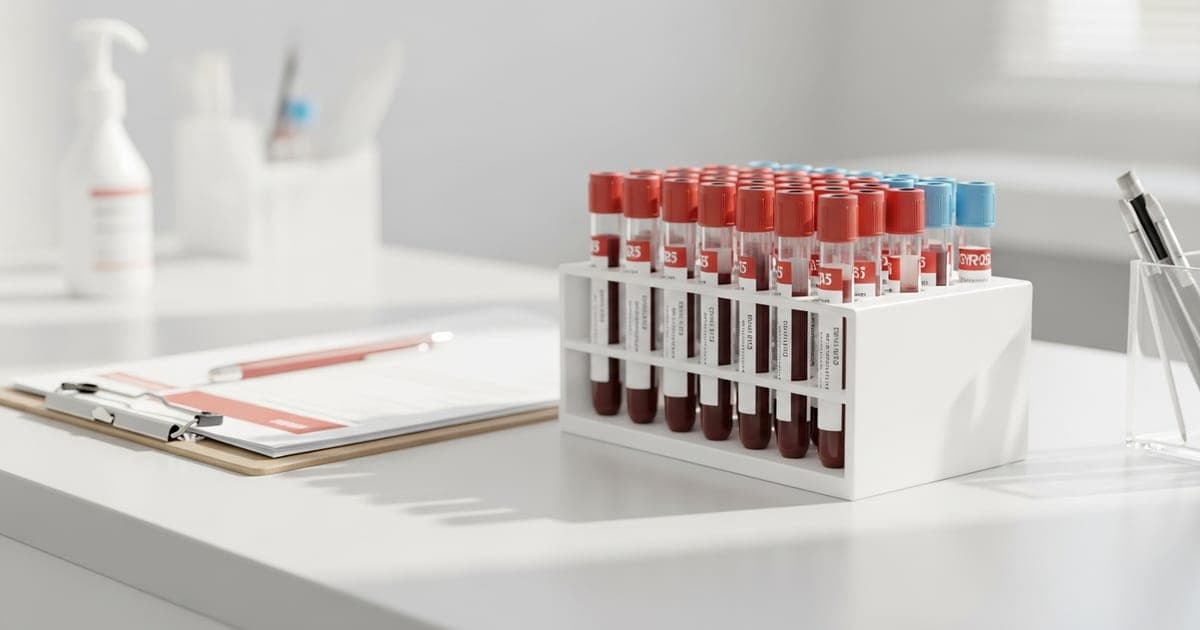
Most families default to a commercial lab or hospital phlebotomy suite when a child needs blood drawn — not because it is the best option, but because it is the most familiar one. A mobile blood draw for kids works differently: a certified phlebotomist travels to your home, performs the draw in your child’s own space, and transports the specimens to the lab. The results go back to your clinician exactly as they would from a lab visit.
Whether that trade-off is right for your family depends on your child, their specific needs, and what the lab order requires. This guide walks through the real differences so you can make an informed choice.
What a mobile blood draw for kids actually looks like
When you schedule a home visit for a child, a certified phlebotomist arrives at your door with a portable kit: the appropriate needles and collection tubes for your child’s panel, antiseptic supplies, specimen labels, bandages, and a temperature-controlled transport container for the samples.
The visit is unhurried. There is no queue behind your child, no waiting room to navigate, and no parking structure to cross. The phlebotomist greets your child, takes a minute for introductions and settling, reviews the lab order with you, and then sets up in whatever space your child is most comfortable — the couch, the kitchen table, or wherever you prefer.
Children typically sit on a parent’s lap for younger ages or in a chair with a parent beside them. The draw itself takes under five minutes for most routine panels. Total visit time from arrival to departure is usually fifteen to twenty-five minutes.
The waiting-room experience versus a home visit
For children who tolerate clinical environments well, a commercial lab visit is entirely reasonable. For many children, however, the waiting room is where the difficulty actually begins — not the needle itself.
A commercial lab visit for a child typically involves:
- Travel and parking (sometimes fasting, which heightens irritability)
- Check-in at a reception desk with strangers
- Time in a waiting room with other patients, unpredictable noise, and no familiar objects
- One or more transitions between rooms (lobby to waiting area to draw room)
- An unfamiliar chair in an unfamiliar room with a stranger performing the draw
Children with anxiety, sensory sensitivities, autism spectrum disorder, ADHD, or a history of difficult medical experiences often reach their distress threshold before the needle is uncapped. Adrenaline from distress constricts veins, which makes the draw harder and increases the chance of multiple sticks.
A home visit removes most of those stressors. The child is already calm in their own environment. The phlebotomist is the only unfamiliar element, and they arrive in a context the child controls (their home, with their parent). The result, for many families, is a meaningfully smoother draw.
When a mobile blood draw is the right choice for kids
A home blood draw is particularly well-suited when your child:
- Has anxiety about medical settings or needles
- Has a developmental or sensory condition that makes clinical environments difficult (autism, sensory processing disorder, ADHD)
- Has had a traumatic prior blood draw experience
- Is medically fragile or homebound and travel to a lab is burdensome
- Requires frequent monitoring draws (chronic conditions) and the cumulative burden of clinic trips is significant
- Is very young (toddler or infant) and the environmental factors at a clinic create excessive distress before the draw begins
It is also simply a convenience choice. Many families with busy schedules, multiple children, or long distances to the nearest lab find that a home visit saves two hours of elapsed time compared to a lab trip — and the child’s recovery (a juice box, a favorite show) happens in their own home rather than a car.
When to use a clinic instead
Mobile phlebotomy is not appropriate for every situation. A clinical or hospital setting is preferable when:
- The draw requires continuous monitoring or physician supervision
- The panel requires equipment not available in a mobile setting (e.g., specialized point-of-care testing)
- The child’s condition requires immediate clinical intervention if a complication arises
- The clinician has specifically ordered an in-facility draw
Your ordering physician or pediatrician can advise whether your child’s specific panel is appropriate for a home draw. For routine panels — CBCs, metabolic panels, thyroid, iron, lead, vitamin levels — home is almost always clinically appropriate.
How to prepare your child for a mobile blood draw
Preparation at home follows the same principles as any pediatric blood draw, with one advantage: the child is already in their comfort zone. Keep your energy calm on the day of the visit, have a distraction ready (tablet, favorite toy, a trusted stuffed animal), and have a snack or juice available for immediately after the draw if your child was fasting.
When you book, let us know your child’s age, any relevant temperament or sensory information, and what works best to keep them calm. We build the appointment around your child’s specific needs — not around a clinical schedule.
Book a Mobile Blood Draw for Your Child
Schedule a home visit with a pediatric-experienced mobile phlebotomist — bring your doctor's lab order, and we handle the rest. Same certified lab, no waiting room.
Sources and further reading
What to bring and how to prepare your child
Good preparation reduces the chance of a difficult draw and makes the visit smoother for your child:
- Have your child hydrated. Encourage water intake the morning of the draw, even if your child is fasting. Hydrated veins are larger and more accessible — this matters especially for small pediatric veins. Fasting instructions always permit water.
- Bring the lab order. Your child's clinician should have sent or given you a paper or electronic lab requisition. Have it ready — the phlebotomist needs it to label tubes correctly.
- Apply topical numbing cream if you have it. EMLA cream or LMX4 applied to the antecubital area (inner elbow) 45–60 minutes before the draw can significantly reduce needle pain. Ask your pediatrician for a prescription; it is particularly useful for children with past difficult draw experiences.
- Let your child bring a comfort item. A stuffed animal, tablet, or favorite toy gives the child something to focus on. Distraction during the draw — watching a show, squeezing a toy — measurably reduces perceived pain in children.
- Dress for easy access. Short sleeves or a sleeve that rolls up easily prevents fumbling and keeps the child from feeling constrained during the draw.
- Do not promise "it won't hurt." Honest, age-appropriate preparation ("there will be a quick sting, then it's over") builds more trust than a broken promise. You can promise "it will be fast" and "I will be right there."
Age-specific considerations
| Age Range | Typical Draw Site | Key Considerations |
|---|---|---|
| Infant (under 1 year) | Heel stick for small volumes; venipuncture for larger panels | Requires pediatric phlebotomist; finger-stick not appropriate for most tests |
| Toddler (1–3 years) | Antecubital or dorsal hand vein | Butterfly (winged) needle; parent lap hold; distraction critical |
| Preschool (3–5 years) | Antecubital vein preferred | Brief explanation helps; EMLA cream beneficial |
| School-age (6–12 years) | Antecubital vein | Can often self-direct breathing/distraction; choose involvement level |
| Adolescent (13+) | Standard antecubital | May prefer privacy; treat as adult with parental presence available |
Cost and insurance for pediatric home blood draws
At-home blood draws for children have the same two-part cost structure as adult draws:
- Mobile phlebotomy service fee: The cost of the home visit. Speedy Sticks charges a flat $150 per visit for individual bookings regardless of how many tubes are collected. This fee is not typically covered by insurance and is paid out of pocket. HSA and FSA funds can generally be applied.
- Lab processing fee: What the reference lab charges to run your child's ordered tests. This is billed directly to your insurance exactly as it would be from a patient service center — same billing codes, same in-network rates, same deductible and copay structure.
For children on Medicaid or state-sponsored plans, confirm coverage for the lab processing component with your plan — most plans cover pediatric lab work ordered by a physician, but the home visit fee remains out-of-pocket.
Pediatric Blood Draws at Your Home
Bring your doctor's lab order. A pediatric-experienced mobile phlebotomist comes to you with butterfly needles and child-adapted technique — same certified reference lab.
Book a visit →