
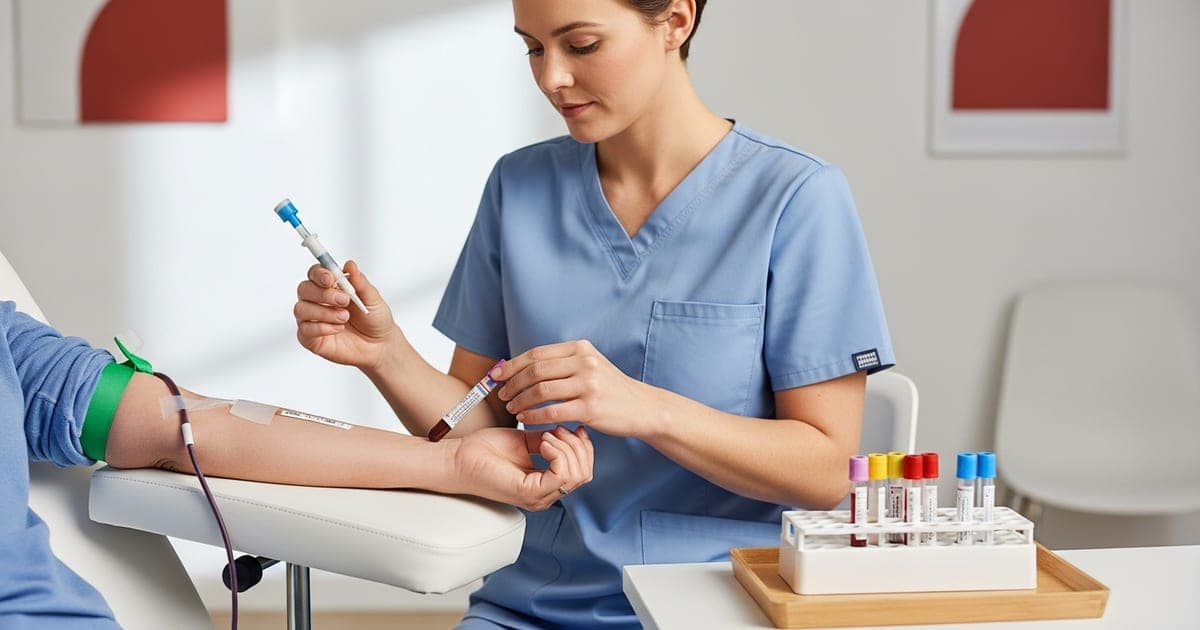
Not all bleeding looks or behaves the same way, and knowing the difference between arterial and venous bleeding matters — both for basic first aid and for understanding what happens during a routine blood draw.
Arterial bleeding
Arteries carry oxygen-rich blood away from the heart under high pressure, generated directly by each heartbeat. When an artery is cut or punctured, blood is typically:
- Bright red — because it is fully oxygenated.
- Spurting or pulsing — in rhythm with the heartbeat, because arterial pressure is much higher and more variable than venous pressure.
- Fast-flowing — arterial bleeding can be severe and, from a major artery, life-threatening within minutes if not controlled.
First-aid guidance from the American Red Cross recommends firm, direct pressure on any actively spurting wound and immediate emergency care — arterial bleeding is not something to wait out.
Venous bleeding
Veins carry deoxygenated blood back to the heart at much lower, steadier pressure. Venous bleeding is typically:
- Dark red to maroon — because the blood has already released its oxygen to the body's tissues, which is also why venous blood can look almost black in a collection tube.
- Steady flow, not pulsing — it oozes or flows continuously rather than spurting with each heartbeat.
- Easier to control — direct pressure for several minutes is usually sufficient to stop venous bleeding, which is exactly what a phlebotomist does at the end of a standard draw.
Capillary bleeding, for comparison
A third category — capillary bleeding, from small surface vessels like a scraped knee or a finger-stick site — oozes slowly and stops quickly on its own with light pressure. It is the mildest of the three categories and rarely requires more than a bandage.
Why this matters for a blood draw
Routine diagnostic blood draws are performed on veins, not arteries — almost always the median cubital vein in the inner elbow, chosen because it is large, close to the surface, and well anchored by surrounding tissue. Venous blood is used for the overwhelming majority of lab tests because it is easier and safer to access, lower pressure, and representative of the blood chemistry the body is circulating. Arterial draws (used for arterial blood gas tests) are a separate, specialized procedure performed mainly in hospital settings to measure oxygen, carbon dioxide, and pH levels directly, and require different technique, training, and post-draw pressure time — typically five minutes or longer, compared to about one to two minutes for a venous draw.
What to expect — and what would be unusual — during a standard draw
During a normal venous blood draw, you should see a steady, non-pulsing flow of dark red blood filling the tube, and bleeding should stop within a minute or two of applying pressure after the needle is withdrawn. If you ever notice pulsing, bright red blood, or unusually fast flow during what should be a routine venous draw, tell your phlebotomist immediately — it can indicate the needle has been placed too deep or has nicked an arterial branch that runs close to the vein, which a trained phlebotomist is taught to recognize and manage right away by withdrawing the needle and applying extended direct pressure.
Why arteries and veins are built differently
The pressure and flow differences come down to basic vessel anatomy. Arteries have thick, muscular, elastic walls built to withstand the surge of pressure from each heartbeat and to help maintain blood pressure between beats. Veins have thinner walls and rely on one-way valves and the surrounding muscles (especially in the legs) to help push blood back toward the heart against gravity, since there is no direct pumping force behind venous blood the way there is behind arterial blood. This structural difference is also why veins are more collapsible and easier to access with a needle without the same bleeding risk as an artery.
Basic first aid for each type of bleeding
For minor venous or capillary bleeding, such as a small cut or the puncture site after a blood draw:
- Apply firm, direct pressure with a clean cloth or gauze for two to five minutes without lifting to check.
- Elevate the area above heart level if possible.
- Apply a bandage once bleeding has stopped.
For suspected arterial bleeding (bright red, spurting blood):
- Apply firm, continuous direct pressure with as much force as needed to control the bleeding.
- Keep the injured area elevated above the heart if possible.
- Call emergency services immediately — arterial bleeding from a significant vessel is a medical emergency, and pressure alone may not be sufficient to control it until professional care arrives.
Need blood drawn at home?
Speedy Sticks sends a certified phlebotomist to your door — no clinic visit required. Book online with your lab order.
Book a Mobile Blood Draw →