
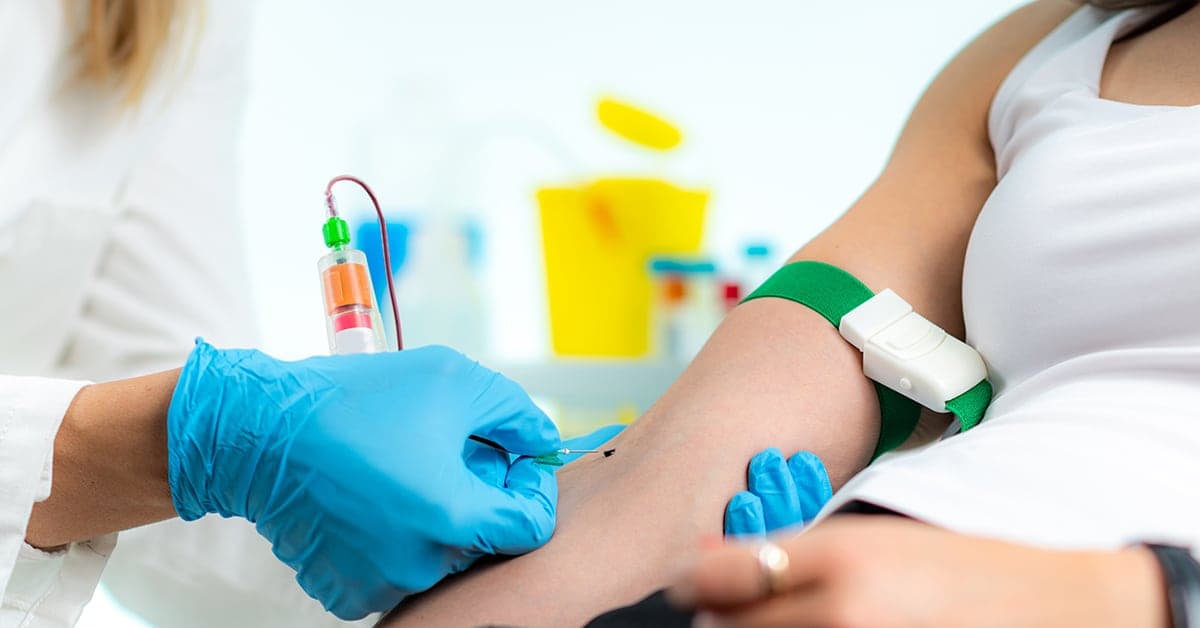
A thyroid blood test primarily measures TSH (thyroid-stimulating hormone) — the pituitary signal that tells your thyroid how hard to work. A normal TSH range is 0.4–4.0 mIU/L in most labs. Fasting is not required. A high TSH indicates hypothyroidism (underactive thyroid); a low TSH indicates hyperthyroidism (overactive thyroid). Abnormal TSH results typically prompt reflex testing for free T4 and, when indicated, thyroid antibodies — all from the same blood draw.
Thyroid test reference ranges
| Test | Normal Range | High Result Suggests | Low Result Suggests |
|---|---|---|---|
| TSH | 0.4–4.0 mIU/L | Hypothyroidism (thyroid underperforming) | Hyperthyroidism or levothyroxine overtreatment |
| Free T4 | 0.8–1.8 ng/dL | Hyperthyroidism; T4 toxicosis | Hypothyroidism; confirms the TSH signal |
| Free T3 | 2.3–4.2 pg/mL | Hyperthyroidism; T3 toxicosis | Severe hypothyroidism; non-thyroidal illness |
| Total T4 | 5.0–12.0 µg/dL | Hyperthyroidism (less specific than free T4) | Hypothyroidism; low protein can falsely reduce |
| Anti-TPO antibodies | <35 IU/mL (negative) | Hashimoto's thyroiditis (autoimmune) | N/A |
| Anti-thyroglobulin Ab | <20 IU/mL (negative) | Hashimoto's or Graves' disease | N/A |
What each thyroid marker measures
TSH — the primary screening test
TSH is produced by the pituitary gland and works like a thermostat signal: when thyroid hormone levels drop, TSH rises to tell the thyroid to produce more. When thyroid hormone is excessive, TSH falls to suppress further production.
This feedback loop makes TSH an extraordinarily sensitive marker — small changes in thyroid output produce large, measurable changes in TSH. This is why TSH is ordered first: it detects thyroid dysfunction earlier and more reliably than measuring thyroid hormones directly. A single normal TSH result is usually sufficient to rule out clinically significant thyroid disease.
Free T4 and free T3
T4 (thyroxine) is the main hormone produced by the thyroid gland. T3 (triiodothyronine) is the active form — most T4 is converted to T3 in peripheral tissues, primarily the liver. "Free" T4 and T3 refer to the unbound, biologically active fraction (not attached to transport proteins), which is what actually exerts effects on tissues.
Free T4 is typically ordered when TSH is abnormal, to confirm whether the thyroid hormone level itself is truly high or low — not just the pituitary signal. Free T3 is ordered less routinely; it is most useful when T3 thyrotoxicosis (isolated T3 elevation) is suspected.
Thyroid antibodies
Anti-TPO (thyroid peroxidase) and anti-thyroglobulin antibodies are ordered when the cause of thyroid dysfunction isn't clear, or when subclinical hypothyroidism (mildly elevated TSH with normal T4) is found. Positive antibodies confirm Hashimoto's thyroiditis — the most common cause of hypothyroidism in the U.S. — which helps predict progression and guides monitoring frequency.
Common thyroid conditions and their test patterns
| Condition | TSH | Free T4 | Antibodies |
|---|---|---|---|
| Primary hypothyroidism | High | Low | Anti-TPO often positive (Hashimoto's) |
| Subclinical hypothyroidism | High | Normal | May be positive |
| Primary hyperthyroidism (Graves') | Low or undetectable | High | TSH receptor antibodies positive |
| Subclinical hyperthyroidism | Low | Normal | Variable |
| Central hypothyroidism (pituitary) | Low or normal | Low | Negative |
| Levothyroxine overtreatment | Low or suppressed | High-normal or high | Varies |
When to take thyroid medication before a blood test
For patients on levothyroxine (Synthroid, Tirosint), the timing of the medication relative to the draw matters:
- Take your levothyroxine after the draw. Most endocrinologists recommend drawing thyroid labs before the morning dose. Levothyroxine taken 4–6 hours before the draw temporarily elevates free T4 and can suppress TSH below its true steady-state level, making the result look like overtreatment.
- If you forgot to delay, note it on your lab slip. Your provider can interpret the result in context, but ideally the test should be repeated under consistent conditions.
- Early morning draws are standard. TSH naturally follows a circadian rhythm — it peaks in the early morning and dips in the afternoon. Labs drawn early in the morning will trend toward the higher end of the normal range; afternoon labs trend lower. Consistent timing makes serial monitoring more meaningful.
Do I need to fast for a thyroid test?
No. Fasting is not required for TSH, free T4, free T3, or thyroid antibody testing. Food does not meaningfully affect thyroid hormone levels or pituitary TSH output. You can eat and drink normally before your draw.
The only situation where fasting may apply is when your thyroid test is ordered alongside fasting panels — such as a lipid panel or fasting glucose. In that case, the fasting instruction applies to those tests, not the thyroid markers.
Who should get a thyroid blood test?
The U.S. Preventive Services Task Force does not recommend universal thyroid screening in asymptomatic adults. However, thyroid testing is appropriate in the following situations:
- Symptoms of hypothyroidism: unexplained fatigue, weight gain, cold intolerance, constipation, dry skin, hair loss, depression, slow heart rate
- Symptoms of hyperthyroidism: unexplained weight loss, palpitations, tremor, heat intolerance, anxiety, frequent bowel movements, eye changes
- Personal or family history of thyroid disease or autoimmune conditions
- Women planning pregnancy or currently pregnant (thyroid function affects fetal development)
- Monitoring established thyroid disease or levothyroxine therapy (typically every 6–12 months once stable)
- After thyroid surgery or radioiodine therapy
- Neck radiation history
Getting a thyroid test at home
A thyroid panel requires a standard blood draw from a vein in the arm. If you are monitoring an established thyroid condition and want to avoid the logistics of a patient service center visit, a mobile phlebotomist can come to your home early in the morning — before your levothyroxine dose — and route the specimen directly to your reference lab.
Speedy Sticks routes to Quest Diagnostics, Labcorp, and most specialty labs. Results are available in your provider's portal on the same timeline as any other lab draw.
Understanding subclinical thyroid disease
Many thyroid abnormalities found on routine blood work are "subclinical" — meaning TSH is outside the reference range but free T4 is still normal, and the patient has no symptoms or very mild symptoms. Understanding these patterns prevents unnecessary alarm:
- Subclinical hypothyroidism (TSH 4–10 mIU/L, normal free T4): Very common, especially in older women. Management is individualized — most providers treat if TSH is above 10, if symptoms are present, if thyroid antibodies are positive (Hashimoto's), or if the patient is pregnant or planning pregnancy. If TSH is 4–7 and antibodies are negative with no symptoms, watchful waiting with repeat testing in 3–6 months is often reasonable.
- Subclinical hyperthyroidism (TSH below 0.4, normal free T4 and T3): Can be caused by excess levothyroxine, thyroid nodules, or early Graves' disease. Even without symptoms, suppressed TSH is associated with atrial fibrillation risk (especially over age 65) and bone density loss, so it typically warrants investigation.
TSH variation and what affects results
TSH is not perfectly stable between draws — several factors create variation that can confuse monitoring:
- Time of day: TSH peaks between midnight and 8 AM and troughs in the afternoon. A 7 AM draw may return a TSH of 3.2 while a 3 PM draw on the same day returns 1.8. For consistency, always draw at the same time of day — preferably early morning.
- Season: TSH is mildly higher in winter months in some populations, possibly related to cold-temperature thyroid adaptation.
- Illness: acute illness (especially fever) can transiently suppress TSH through "non-thyroidal illness syndrome." A TSH result during or immediately after a serious illness should be repeated when recovered before concluding there is a true thyroid disorder.
- Biotin supplementation: high-dose biotin (as found in some hair/nail supplements, typically 5,000–10,000 mcg) can interfere with immunoassay-based thyroid tests and produce falsely abnormal TSH and T4 values. Stop biotin for at least 48 hours before a thyroid panel.
Thyroid panel at home
TSH, free T4, free T3 — drawn at your door before your morning medication. Certified phlebotomist routes results to your preferred reference lab.
Book a visit →