
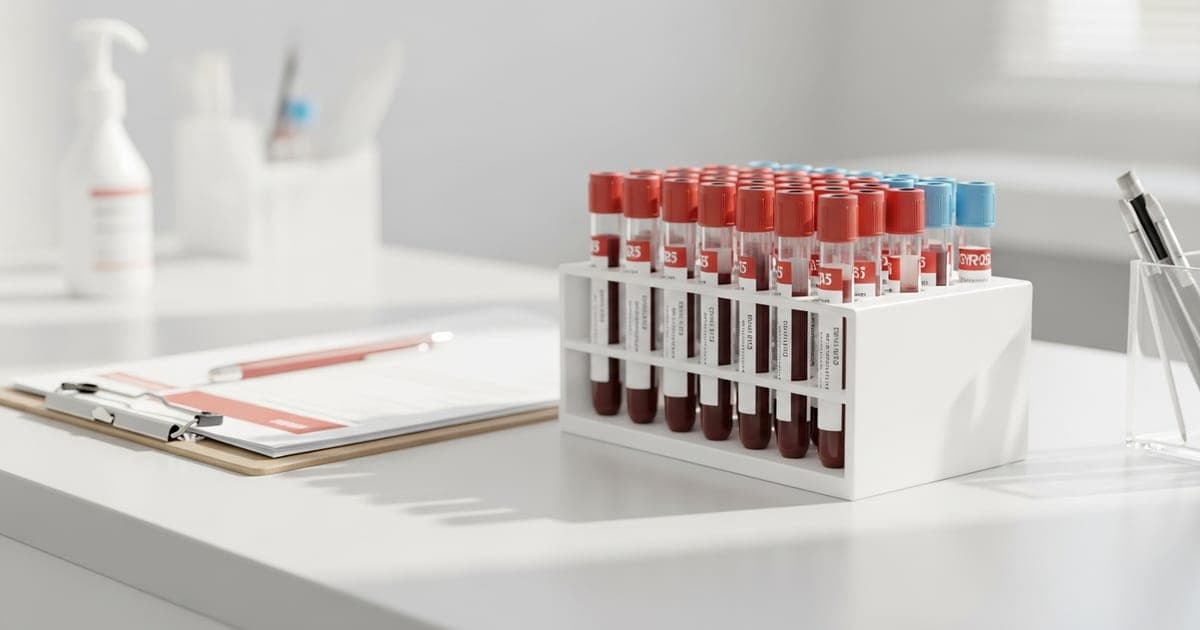
A lipid panel measures the fats circulating in your bloodstream: total cholesterol, LDL cholesterol, HDL cholesterol, and triglycerides. It is one of the most widely ordered preventive tests because elevated LDL and low HDL are major modifiable risk factors for coronary artery disease, stroke, and peripheral vascular disease — all conditions that often progress silently before symptoms appear. A lipid panel requires a blood draw and typically needs 9–12 hours of fasting for the most accurate results.
Lipid panel normal ranges
| Marker | Optimal | Borderline | High Risk |
|---|---|---|---|
| Total Cholesterol | Below 200 mg/dL | 200–239 mg/dL | 240 mg/dL or above |
| LDL Cholesterol | Below 100 mg/dL | 130–159 mg/dL | 160 mg/dL or above |
| HDL Cholesterol | 60 mg/dL or above | 40–59 mg/dL (M) / 50–59 mg/dL (F) | Below 40 mg/dL (M) / Below 50 mg/dL (F) |
| Triglycerides | Below 150 mg/dL | 150–199 mg/dL | 200 mg/dL or above |
| Non-HDL Cholesterol | Below 130 mg/dL | 130–189 mg/dL | 190 mg/dL or above |
These are general adult targets from ACC/AHA guidelines. Individual targets vary based on personal cardiovascular risk, family history, presence of diabetes, or prior cardiac events. Your provider may set a lower LDL target if you have known heart disease.
What each lipid panel component measures
LDL cholesterol ("bad" cholesterol)
LDL particles carry cholesterol from the liver to peripheral tissues. When LDL is elevated, excess cholesterol deposits in artery walls, forming plaques — the core mechanism of atherosclerosis. Plaque buildup narrows arteries over decades and can rupture, triggering a heart attack or stroke.
LDL is not directly measured in most standard panels — it is calculated using the Friedewald equation from total cholesterol, HDL, and triglycerides. This is why fasting matters: high triglycerides (often from a recent meal) artificially deflate the calculated LDL, giving a falsely reassuring result.
For most healthy adults the target is LDL below 100 mg/dL. For people with established cardiovascular disease or diabetes, guidelines recommend below 70 mg/dL. Very high-risk patients may target below 55 mg/dL.
HDL cholesterol ("good" cholesterol)
HDL particles perform reverse cholesterol transport — they pick up excess cholesterol from artery walls and return it to the liver for processing. Higher HDL is associated with lower cardiovascular risk, which is why it is sometimes called "good" cholesterol.
Low HDL (below 40 mg/dL in men, below 50 mg/dL in women) is an independent risk factor for heart disease even when LDL is controlled. Factors that lower HDL include physical inactivity, smoking, obesity, high triglycerides, type 2 diabetes, and certain medications (beta-blockers, some diuretics).
HDL above 60 mg/dL is considered cardioprotective and is counted as a negative risk factor — it partially offsets other risk factors in standard cardiovascular risk calculators.
Triglycerides
Triglycerides are the most common form of fat in your body — essentially stored energy from carbohydrates and dietary fats that weren't immediately used. High triglycerides are associated with cardiovascular disease, particularly when combined with low HDL and high LDL — a pattern called "atherogenic dyslipidemia."
Triglycerides are highly responsive to recent food and alcohol intake, which is why fasting is particularly important for this marker. A non-fasting triglyceride level above 175 mg/dL is considered elevated; a fasting level above 150 mg/dL warrants attention. Very high triglycerides (above 500 mg/dL) raise the risk of pancreatitis.
Total cholesterol and non-HDL cholesterol
Total cholesterol is the sum of LDL, HDL, and 20% of triglycerides. As a standalone number it is less informative than the individual components — high total cholesterol driven by high HDL has very different implications than high total cholesterol driven by high LDL.
Non-HDL cholesterol (total cholesterol minus HDL) includes LDL plus VLDL and IDL — all the atherogenic particles. It is increasingly used as a more complete marker of cardiovascular risk than LDL alone, especially in people with high triglycerides where calculated LDL may be unreliable.
Fasting requirements for a lipid panel
The traditional standard is 9–12 hours of fasting before a lipid panel:
- Water is always permitted — staying well-hydrated makes the draw easier and does not affect lipid values
- Morning draws are ideal — a fasting draw first thing in the morning is the most practical way to complete the fast without disrupting your day
- Black coffee without cream or sugar — many providers permit this; check the specific instructions on your lab order
- Alcohol should be avoided for 24 hours before a fasting panel — alcohol significantly raises triglycerides and can confound results
Non-fasting lipid panels are increasingly accepted for routine cardiovascular risk screening in adults with no known lipid disorders. A 2016 European consensus statement and subsequent ACC/AHA guidance noted that non-fasting panels are clinically useful for most screening purposes. However, if your triglycerides came back elevated on a non-fasting panel, a fasting repeat is often ordered to get a more accurate LDL calculation.
What can affect lipid panel results
Beyond fasting status and recent food intake, several other factors affect results:
- Recent illness or infection — acute illness temporarily lowers LDL and total cholesterol; wait 4–6 weeks after a significant illness for an accurate baseline
- Pregnancy — total cholesterol, LDL, and triglycerides all rise during pregnancy; lipid values in pregnancy are interpreted differently
- Thyroid function — hypothyroidism raises LDL and total cholesterol; lipid panels often improve substantially after thyroid treatment
- Medications — statins, fibrates, niacin, and certain diabetes medications all affect lipid values; inform your provider of all medications
- Recent weight change — significant weight loss typically improves the lipid profile; significant weight gain worsens it
When lipid panel results require action
A single lipid panel is a snapshot, not a verdict. Most providers repeat an abnormal panel before initiating treatment, and treatment decisions are based on total cardiovascular risk — not a single number. That said, certain results typically prompt immediate discussion:
- LDL above 190 mg/dL — suggests familial hypercholesterolemia, a genetic condition requiring treatment regardless of other risk factors
- Triglycerides above 500 mg/dL — independent risk for pancreatitis; typically treated promptly
- Total cholesterol above 300 mg/dL — warrants further investigation and usually a full cardiovascular risk assessment
Getting a fasting lipid panel at home
The biggest logistical challenge of a fasting lipid panel is getting to a lab first thing in the morning after fasting overnight. A mobile phlebotomist eliminates that problem — they come to your home in the early morning window when fasting is already complete, draw your sample, and route it directly to your reference lab.
Speedy Sticks schedules early-morning fasting appointments and handles routing to Quest Diagnostics, Labcorp, or your provider's preferred lab. Results are available in your patient portal on the same timeline as a patient service center draw.
Fasting lipid panel at home
Skip the morning drive to the lab. A certified Speedy Sticks phlebotomist draws your fasting lipid panel at home and routes it directly to your reference lab.
Book a visit →For employers: a lipid panel is one of the core measures in employee biometric screening. Speedy Sticks collects it on-site or at home with a venous draw sent to a reference lab, alongside BMI and blood pressure. Employers can build a custom panel from any test on the Labcorp or Quest menu.