
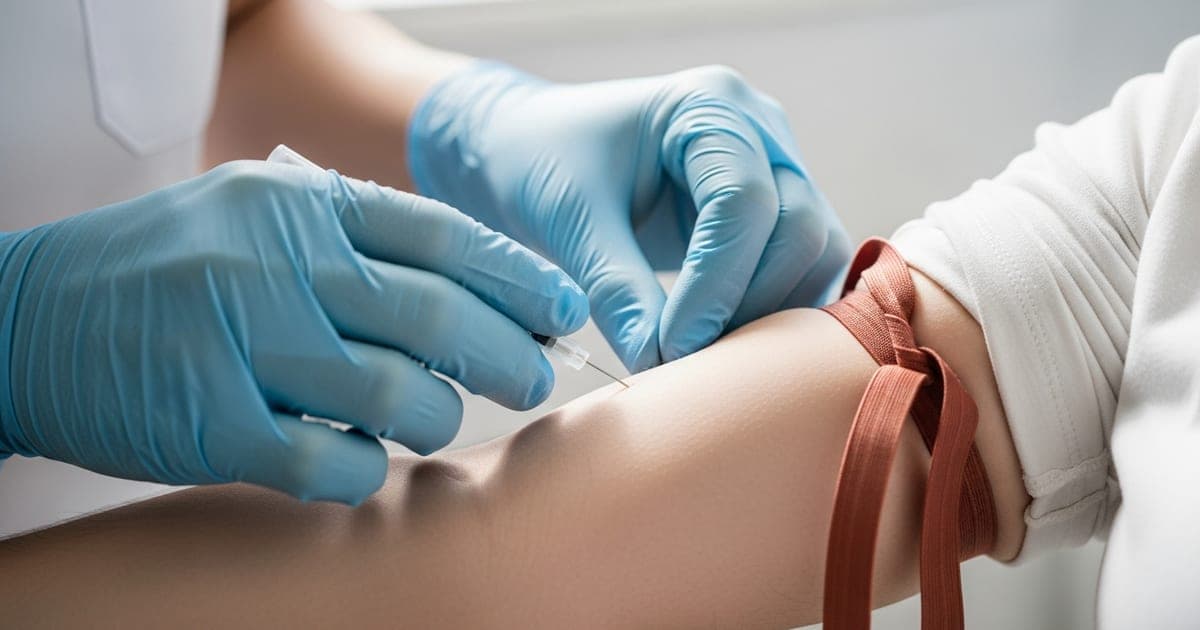
Some blood draws go smoothly from start to finish. Others take longer, require extra technique, or need a second attempt. Neither outcome reflects on the patient — difficult sticks are a normal part of phlebotomy, and experienced phlebotomists expect and plan for them. Here is why some draws are harder, and exactly what our team does when they are.
8 Reasons Blood Draws Are Difficult — and What Phlebotomists Do About Each
| Cause | Why It Happens | Phlebotomist's Solution |
|---|---|---|
| Dehydration | Low fluid volume makes veins collapse or flatten under needle pressure | Ask patient to drink 16–32 oz water 30–60 min before draw; use warm compress to dilate |
| Small veins | Genetics, low body weight, or poor venous development | Switch to 23g butterfly needle; use hand dorsal veins or forearm instead of antecubital |
| Rolling veins | Veins that shift laterally instead of staying fixed under needle pressure | Apply two-finger traction to anchor the vein; slower, shallower insertion angle |
| Anxiety / vasovagal response | Stress causes vasoconstriction; veins appear and dilate less | Allow patient to lie down; warm compress; distraction technique; talk through the process |
| Scarring from repeated draws | Prior needle sites scar over, making vein walls less penetrable | Rotate sites; avoid old scar tissue; try opposite arm |
| Obesity | Veins are deeper and harder to palpate under subcutaneous tissue | Use longer needle; locate by palpation rather than sight; ultrasound guidance in clinical settings |
| Chemotherapy / IV drug use | Repeated IV access damages vein walls; sclerosis (hardening) develops | Detailed patient history to find least-damaged site; may require specialist access |
| Cold temperature | Cold causes vasoconstriction; veins narrow and retreat deeper | Warm the site for 3–5 minutes before draw; perform draw in a warm room |
Dehydration and small veins
Hydration is the single biggest controllable factor in how easy or difficult a blood draw will be. When you are well-hydrated, your veins fill with fluid and become larger, firmer, and easier to locate and puncture cleanly. When you are dehydrated, veins shrink, collapse more easily under the needle, and can roll away during the stick.
The practical protocol: drink 16 to 32 ounces of water in the 30 to 60 minutes before your appointment. If you are fasting, you can still drink plain water — it does not affect most lab results and significantly improves vein access. Avoid coffee and caffeinated drinks in the hours before the draw; caffeine is a mild diuretic that works against you. If your appointment is in the morning, start drinking water when you wake up.
A warm compress or warm towel applied to the inner elbow for two to three minutes before the draw causes vasodilation — the vein widens slightly in response to warmth, making it easier to find and access. Our phlebotomists carry warming supplies for exactly this purpose.
Vein depth and anatomy
Some people simply have veins that sit deeper under the skin, are naturally smaller in diameter, or roll to the side when a needle approaches. This is anatomy, not a problem the patient caused. Obesity, thin or fragile skin in older adults, and certain chronic conditions (chronic kidney disease, a history of frequent IV access) all affect vein accessibility.
Our phlebotomists are trained to assess vein anatomy before committing to a puncture site. We palpate (feel) before we stick, look for visible veins under good lighting, and consider multiple sites: the antecubital fossa (inner elbow) is first choice, but the forearm, hand, and wrist are all viable alternatives when the elbow is not accessible.
Anxiety-related vein constriction
When a patient is anxious or frightened, the sympathetic nervous system releases adrenaline. One of adrenaline’s direct effects is vasoconstriction — the veins narrow. This is the body preparing for “fight or flight,” and it makes a phlebotomist’s job meaningfully harder. A patient who was well-hydrated before the appointment may still present with difficult access simply because their veins have constricted from anxiety.
The at-home blood draw helps here in a way that is often underestimated. Clinical environments compound anxiety — the waiting room, unfamiliar faces, fluorescent lighting, and the formal medical setting all contribute to the stress response. At home, most patients are already calmer before we arrive, and vein access is often easier as a result.
Cold temperatures
Cold causes veins to constrict and retreat from the skin’s surface, just as the body conserves heat. If a patient comes in from cold weather or keeps their home very cool, vein access can be significantly harder than it would be on a warm day. Warming the arm before the draw — as described above — addresses this directly. We will always warm the site before accessing it if the patient is cold.
Age-related vein changes
As people age, veins become less elastic and more fragile. The surrounding tissue also changes in ways that make veins easier to miss and easier to bruise. Older adults on blood thinners (warfarin, apixaban, aspirin) require extra care with pressure after the draw to prevent bruising. This is not a contraindication for home blood draws — it simply requires a phlebotomist who is experienced with the geriatric patient population, which our team is.
What Speedy Sticks phlebotomists do when a draw is difficult
When standard access at the antecubital site is not working, we have a clear escalation sequence:
- Warm the site. Apply a warm pack for two to three minutes and reassess.
- Switch arms. The non-dominant arm may have different and more accessible vein anatomy.
- Switch to a butterfly needle. A 23- or 25-gauge butterfly (winged infusion set) gives us more control and flexibility than a straight needle, and causes less trauma to fragile or small veins.
- Try alternative sites. The dorsal hand veins, the forearm, and occasionally the wrist are all usable alternatives when the elbow is inaccessible.
- Pause and reset. If a patient is anxious, we pause, have a conversation, give them time to breathe and relax, and try again when the vasoconstriction has eased.
- Call for a second phlebotomist. In rare cases where multiple standard attempts have not succeeded, we will bring in a second Speedy Sticks phlebotomist rather than continue to attempt on the same patient. A difficult stick is not a failure — pushing past reasonable attempts does not serve the patient.
We never exceed two attempts per site. Patient comfort and trust are the priority, and a rescheduled draw with better preparation is always better than a traumatic one.
Patients with consistently difficult draws often find home visits through mobile phlebotomy more successful — the relaxed environment reduces vasoconstriction, and a mobile phlebotomist can take more time per patient than a high-volume lab setting allows.
Sources and further reading
Difficult Draws? Our Phlebotomists Specialize in Them
Speedy Sticks phlebotomists handle rolling veins, small veins, and needle-anxious patients regularly. A calm home setting and experienced technique make the difference.
Book a visit →