
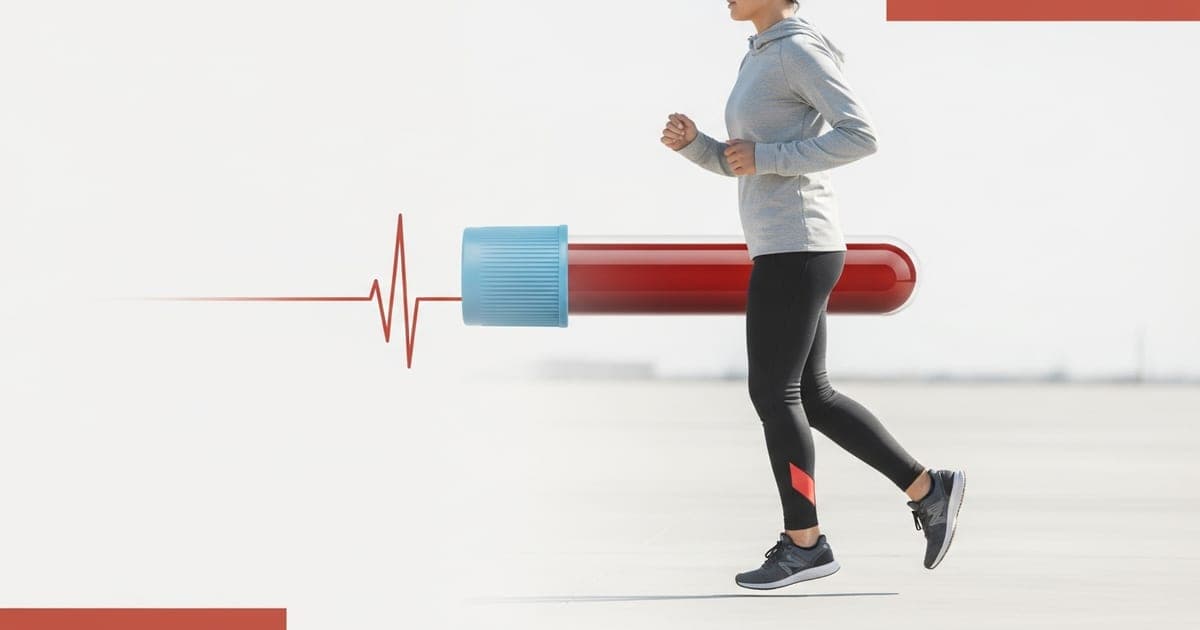
Exercise — even a moderate workout — can measurably alter several blood test values and in some cases produce results that look concerning when they are simply a reflection of recent physical activity. Whether you need to skip your workout before a draw depends entirely on which tests were ordered.
Which Blood Tests Are Affected by Exercise?
| Test | Effect of Recent Exercise | How Long to Wait |
|---|---|---|
| CK (creatine kinase) | Can rise 2–10× normal after intense activity; may falsely suggest cardiac or muscle disease | 24–48 hrs after intense exercise |
| AST / ALT (liver enzymes) | CK cross-reactivity elevates AST; moderate ALT elevation also seen post-exercise | 24–48 hrs for accurate baseline |
| LDH | Released from muscle cells during exercise; can mimic hemolysis pattern | 24 hrs minimum |
| WBC (white blood cell count) | Transiently elevated during and immediately after strenuous activity (exercise leukocytosis) | 2–4 hrs for return to baseline |
| Blood glucose | Drops during aerobic exercise; rises transiently in intense anaerobic effort; affects fasting glucose interpretation | Fast separately; avoid exercise during fast |
| Uric acid | Rises with high-intensity exercise and dehydration; can mimic gout flare on lab paper | 24 hrs for routine gout workup |
| Triglycerides | Lower immediately post-exercise; single workout can drop triglycerides 20–30% | Fast 12 hrs; no vigorous exercise 24 hrs before lipid panel |
| Lipid panel (total, HDL, LDL) | Relatively stable; LDL transiently lower post-exercise; HDL slightly higher | 24 hrs recommended before lipid panel draw |
| CBC (RBC, hemoglobin, hematocrit) | Mild dilutional change from plasma expansion during exercise; RBC count slightly higher post-activity | 2–4 hrs for routine CBC |
| BMP / CMP (electrolytes, kidney) | Potassium transiently elevated; sodium and creatinine affected by hydration; mostly minor | Hydrate well; 2–4 hrs rest |
| TSH (thyroid) | Not clinically affected by routine exercise | No restriction needed |
| PSA (prostate-specific antigen) | Vigorous cycling raises PSA falsely; avoid cycling 48–72 hrs before PSA draw | 48–72 hrs after vigorous cycling |
Why Does Exercise Affect Blood Tests?
Physical activity triggers a cascade of physiological responses that directly alter what is circulating in your blood:
- Muscle breakdown: exercise causes microscopic muscle fiber damage that releases creatine kinase (CK), lactate dehydrogenase (LDH), and myoglobin into the bloodstream
- Liver enzyme release: AST and ALT are found in both liver and muscle — exercise can elevate both significantly, mimicking liver injury on a standard metabolic panel
- Inflammation markers: high-intensity exercise elevates CRP and ESR transiently for 24–72 hours
- Hormonal changes: cortisol, epinephrine, and testosterone all shift acutely and take hours to return to baseline
- Fluid shifts: exercise-induced sweating concentrates the blood, raising hematocrit, hemoglobin, and sodium values
- Blood glucose: exercise lowers blood glucose acutely; the glucose-lowering effect can persist for hours
Which Tests Are Significantly Affected by Exercise?
Avoid intense exercise 24+ hours before these tests:
- Creatine Kinase (CK/CPK): the most exercise-sensitive value. Intense resistance training can raise CK by 10–20x above normal for 24–72 hours. Elevated CK is also a marker of myocardial infarction and rhabdomyolysis — exercise-elevated CK can trigger unnecessary cardiac workups.
- AST and ALT (liver enzymes): exercise raises both. If your doctor ordered a metabolic panel to assess liver function, exercising the day before can produce falsely abnormal results.
- Lactate Dehydrogenase (LDH): present in muscle and red blood cells. Exercise elevation creates interpretive ambiguity alongside other LDH-elevating conditions.
- Troponin: cardiac troponin can be elevated in endurance athletes (marathon runners, triathletes) for 24–72 hours after intense exertion — without any cardiac injury. This is called "exercise-induced troponin elevation" and is well-documented.
- CRP and ESR: both inflammation markers rise transiently after intense exercise and can remain elevated for 24–72 hours.
- Testosterone and cortisol: both shift with acute exercise. For hormone tests, early morning draws before any physical activity are the clinical standard.
Which Tests Are Minimally Affected?
- Lipid panel: a single moderate workout has minimal impact on total cholesterol, LDL, HDL, or triglycerides
- Thyroid (TSH): not significantly affected by routine exercise in healthy individuals
- HbA1c: reflects a 3-month average — a single workout has no impact
- Blood type: unaffected
How Long to Wait After Exercise Before a Blood Draw
- CK / CPK: 48–72 hours (up to 5 days after very heavy training)
- AST and ALT: 24–48 hours
- Troponin (endurance athletes): 48–72 hours after a marathon or extreme effort
- CRP / ESR: 24–48 hours
- Testosterone / cortisol: 24 hours; ideally draw in early AM in rested state
- Cholesterol, thyroid, HbA1c: no specific exercise restriction
What to Tell Your Phlebotomist
Always mention recent vigorous exercise before a draw — especially if you exercised in the past 48 hours before a CK, liver enzyme, or troponin test. Documenting "patient exercised within 24 hours" on the lab requisition allows the physician to interpret elevated values in context and avoid unnecessary follow-up testing.
Make Your Draw Convenient — Morning Home Draws
For hormone tests and metabolic panels, early morning draws before any workout are the gold standard. With Speedy Sticks, you can book an early morning home draw that arrives right after you wake up, before any exercise. Book your visit here.
This content is for informational purposes only and is not a substitute for professional medical advice.
Sources and further reading
How to schedule your draw around exercise
The practical recommendation depends on what you are being tested for:
- Routine annual wellness panel (CBC, CMP, lipids, thyroid, HbA1c): Light to moderate exercise the day before is generally fine. Skip intense workouts — weightlifting, HIIT, long runs — for 24 hours before your draw.
- Liver function (AST, ALT, GGT): No heavy exercise for 48 hours before. Even a moderately strenuous gym session elevates AST from muscle breakdown — not just liver damage.
- Cardiac workup (troponin, BNP): If you are an endurance athlete, disclose your training history. Exercise-induced troponin elevation from a recent marathon can persist for 48–72 hours and can confuse a cardiac evaluation.
- Hormone panels (testosterone, cortisol, DHEA): Early morning rested draws are the standard. Any exercise before the draw — even a walk — can shift these values. Schedule for first thing in the morning on a rest day.
- Fasting panels (lipids, glucose, insulin): If you are fasting overnight for a morning draw, do not exercise before — exercising in a fasted state exaggerates certain metabolic responses and can affect glucose readings.
Why exercise raises certain blood markers
Understanding the mechanism helps you make smarter scheduling decisions:
- Muscle enzymes (CK, AST, LDH): Exercise creates micro-tears in muscle fibers. As cells repair, these enzymes leak into the bloodstream. The more intense the exercise and the larger the muscle groups involved, the higher the rise. Eccentric exercise (downhill running, heavy squats, resistance training) is particularly potent.
- WBC elevation: Exercise triggers a physiological stress response — catecholamines (adrenaline) demarginate white blood cells from vessel walls into circulation, temporarily raising the WBC count. This is normal and typically resolves within a few hours.
- Lactic acid and pH shifts: Intense anaerobic exercise raises lactate and transiently lowers blood pH. This rarely matters for standard panels but can affect some metabolic markers.
- Dehydration: Exercise-related fluid loss concentrates your blood. Even mild dehydration artificially raises hematocrit, hemoglobin, BUN, creatinine, and electrolytes by reducing plasma volume.
Staying well-hydrated before any draw — fasted or not — mitigates the concentration effect of both exercise and overnight fluid restriction.
No-Rush Morning Draw — Done at Home
Skip the early commute. A mobile phlebotomist arrives at your home for your morning draw — no gym, no rushing, no waiting room. Show up exactly as your provider instructed.
Book a visit →