
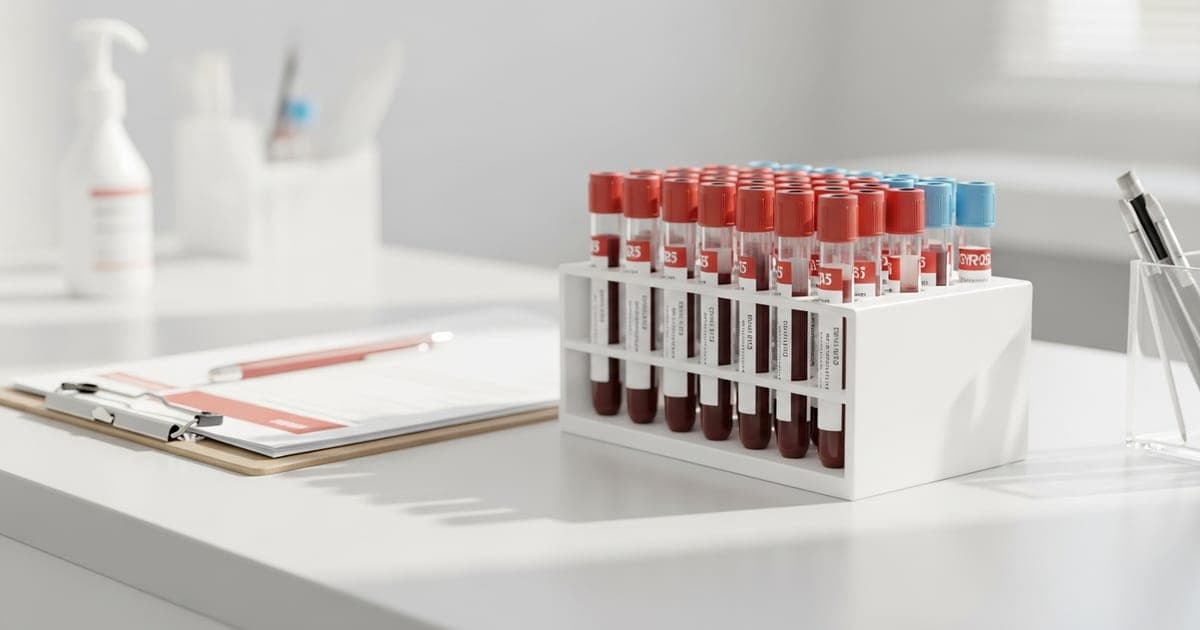
Your doctor ordered a second blood test, and now you are wondering what it means. In most cases, being asked to repeat a blood test is routine — not an indication that something is seriously wrong. Blood tests are ordered again for a range of clinical reasons, many of which are procedural or precautionary rather than alarming. Here are the seven most common reasons.
7 Reasons Your Doctor Ordered a Repeat Blood Test
| Reason | What It Means | How Urgent? |
|---|---|---|
| Borderline result | Value fell just outside the reference range; single borderline results are often noise, not disease | Not urgent — typically repeated in 4–12 weeks |
| Confirming an abnormal | A clearly abnormal result needs confirmation before diagnosis or treatment starts | Usually 1–2 weeks; urgent if values are critically abnormal |
| Monitoring a known condition | Diabetes, thyroid disease, kidney disease, or lipids on treatment require interval checks to track response | Routine — schedule-driven, not triggered by a bad result |
| Suspected lab error or hemolysis | Potassium, LDH, and other markers rise artifactually in hemolyzed samples; lab flags and requests a redraw | Usually same-day or next-day redraw |
| Non-fasting result needs fasting confirmation | Glucose or lipids drawn non-fasting need a fasting draw to be interpretable | Schedule at patient's convenience |
| Medication adjustment | After starting, stopping, or changing a dose (statin, levothyroxine, metformin), labs are repeated to confirm the desired effect | 4–8 weeks after dose change |
| Acute illness affecting chronic baseline | A cold, infection, or hospitalization distorts chronic markers (CRP, WBC, lipids); repeat after recovery | 2–4 weeks post-illness |
1. The Test Requires Confirmation Before Diagnosis
For many conditions, a single abnormal result is not sufficient to make a diagnosis. Medical standards require confirmation:
- Diabetes: the American Diabetes Association requires two separate fasting glucose results of ≥126 mg/dL, or one confirmed by a second test (HbA1c ≥6.5%), before diagnosis
- Hypothyroidism: a mildly elevated TSH on a first draw is often repeated 4–8 weeks later before starting thyroid hormone replacement, because transient TSH elevations are common after illness
- Elevated PSA: a high prostate-specific antigen is typically repeated 4–6 weeks later before a urology referral, because PSA can be transiently elevated after prostate instrumentation, infection, or recent ejaculation
In these cases, the repeat is a quality-control step built into the diagnostic algorithm — not a sign that your doctor is unsure.
2. A Value Was Borderline
Blood test reference ranges are population-based averages, not absolute biological cutoffs. A result just outside the normal range — slightly elevated creatinine, a low-normal hemoglobin, or borderline cholesterol — may mean very little on its own. Your doctor will re-test 4–12 weeks later to see whether the value persists, resolves, or worsens. A persistent borderline result is clinically different from a one-time borderline result. Many borderline findings normalize on repeat testing without any intervention.
3. The Sample Could Not Be Processed
Laboratory pre-analytical issues are more common than most patients realize. Reasons a sample may be rejected or produce an uninterpretable result:
- Hemolysis: red blood cells broke open during collection or transport, releasing intracellular contents (especially potassium) and interfering with multiple assays. A hemolyzed potassium cannot be reported accurately.
- Lipemia: visibly milky serum from a non-fasting draw — fat particles interfere with photometric analyses
- Clotted sample: a tube not adequately mixed with its anticoagulant may clot, making certain tests unrunnable
- Insufficient volume: not enough blood collected to run all ordered tests
- Labeling discrepancy: patient ID on the tube does not match the requisition — a safety issue that prevents reporting under any patient name
A repeat draw in these situations is a technical necessity, not a clinical concern.
4. You Are Being Monitored for a Known Condition
For chronic conditions, repeat blood tests at regular intervals are the standard of care — not a response to a specific abnormal result:
- CKD: creatinine, BUN, and eGFR monitored every 3–12 months depending on stage
- Diabetes: HbA1c every 3 months until stable, then every 6 months; annual CMP for kidney and liver function
- Thyroid disease: TSH checked 6–8 weeks after any dose change, then annually
- Anticoagulation (warfarin): INR checked weekly to monthly depending on stability
5. A Medication Needs Monitoring
Many common medications require routine bloodwork to confirm they are working and not causing harm:
- Statins: annual ALT/AST to screen for liver stress; CK if muscle symptoms develop
- Metformin: annual creatinine and eGFR — metformin is contraindicated in severe kidney impairment
- ACE inhibitors / ARBs: creatinine and potassium 1–2 weeks after starting or dose change
- Lithium: serum lithium levels, creatinine, and thyroid function at regular intervals
- Methotrexate: CBC, liver enzymes, and creatinine every 4–12 weeks
6. You Did Not Follow Pre-Test Instructions
Many blood tests require specific preparation that directly affects accuracy. If instructions were not followed, the result may be unreliable:
- Fasting required but not done: glucose, insulin, triglycerides, and some hormones require fasting; a non-fasting draw for these produces results that cannot be compared to standard reference ranges
- Vigorous exercise before a draw: CK, AST, and troponin can be significantly elevated by exercise within 24–48 hours
- Dehydration: concentrated blood affects creatinine, BUN, hematocrit, and electrolytes
7. An Unexpected Result Needs Clinical Context
Occasionally, a result comes back genuinely unexpected — not borderline, but significantly outside the expected range given your clinical picture. Before changing your treatment plan based on a single surprising result, your doctor will often repeat the test to confirm it is real and not an analytical error, a labeling mix-up, or a transient physiological variation. This is sound clinical practice — a single dramatically abnormal result that does not fit your clinical picture deserves confirmation before irreversible treatment decisions are made.
What to Do Before Your Repeat Draw
- Ask why you are repeating. Your doctor or their nurse can tell you in 30 seconds which of these reasons applies — knowing the reason makes the wait less stressful.
- Follow preparation instructions carefully. If fasting, proper hydration, or medication timing was an issue the first time, address it.
- Book a convenient draw. Speedy Sticks sends a certified phlebotomist to your home so your repeat draw does not require another clinic trip. Schedule here.
This content is for informational purposes only and is not a substitute for professional medical advice. Always consult your physician about your specific test results.
Sources and further reading
Repeat Draws Made Easy — at Home
Follow-up blood panels don't have to mean another clinic trip. A mobile phlebotomist comes to you for repeat draws — same reference lab, results sent to your provider.
Book a visit →