
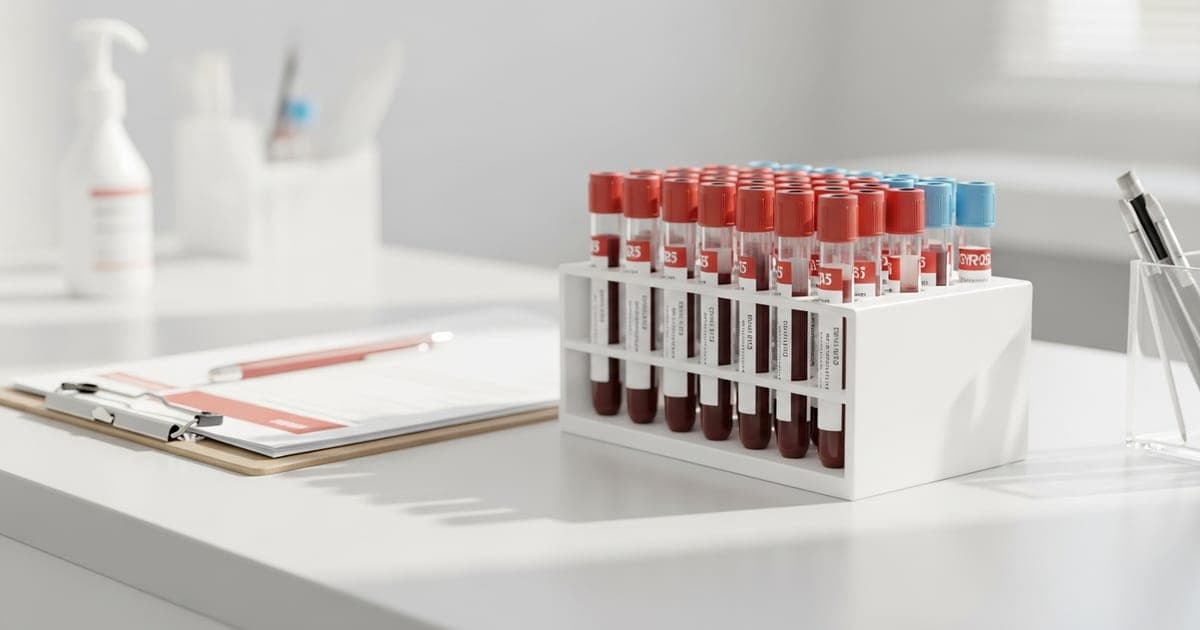
A vitamin D blood test measures 25-hydroxyvitamin D (25-OH D) — the storage form of vitamin D circulating in your blood. It is the most accurate way to assess your overall vitamin D status. The test requires a standard blood draw and does not require fasting. Results are reported in nanograms per milliliter (ng/mL) or nanomoles per liter (nmol/L), depending on the lab.
Vitamin D level reference ranges
| 25-OH D Level (ng/mL) | Classification | What It Means |
|---|---|---|
| 50+ ng/mL | High / Possible toxicity zone | Above typical supplementation targets; toxicity risk above 100 ng/mL |
| 30–50 ng/mL | Optimal (many practitioners) | Target range for many functional medicine and preventive care protocols |
| 20–29 ng/mL | Sufficient (Endocrine Society) | Meets the minimum for bone health per most clinical guidelines |
| 12–19 ng/mL | Insufficient | Below optimal; associated with impaired bone mineralization |
| Below 12 ng/mL | Deficient | Significantly low; associated with rickets in children, osteomalacia in adults |
Reference ranges vary slightly between labs. Some use 30 ng/mL as the lower bound of sufficiency; others use 20 ng/mL. Your report will show your lab's specific reference interval.
What vitamin D does in the body
Vitamin D is a fat-soluble vitamin that functions more like a hormone than a traditional nutrient. Its most established role is in calcium and phosphorus absorption — without adequate vitamin D, the gut cannot absorb dietary calcium efficiently, leading to bone loss over time.
Beyond bone health, vitamin D receptors are found in nearly every tissue in the body, and ongoing research links vitamin D status to immune function, muscle function, cardiovascular health, and mood regulation. These associations are well-established enough that low vitamin D is a recognized clinical finding — not just a wellness concern.
How the body makes and gets vitamin D
Vitamin D is unique among vitamins because the body can synthesize it: ultraviolet B (UVB) radiation from sunlight triggers the skin to produce vitamin D3 (cholecalciferol). That precursor is then converted in the liver to 25-OH D — the form measured on the blood test — and then converted again in the kidneys to the active form (1,25-dihydroxyvitamin D, or calcitriol) when the body needs it.
Factors that limit sun-derived vitamin D include:
- Living at latitudes above 35 degrees north or below 35 degrees south (most of the continental U.S. north of Atlanta)
- Spending most of the day indoors
- Consistent sunscreen use that blocks UVB
- Darker skin tone (higher melanin reduces UVB penetration)
- Older age (skin synthesis becomes less efficient with age)
- Winter months, when UVB angle is insufficient for synthesis at northern latitudes
Dietary vitamin D is limited — the main food sources are fatty fish (salmon, mackerel, sardines), egg yolks, beef liver, and fortified foods (milk, orange juice, cereals). Most people in the U.S. cannot meet optimal vitamin D levels through diet alone without supplementation or adequate sun exposure.
Symptoms of vitamin D deficiency
Many people with low or insufficient vitamin D have no noticeable symptoms — which is why testing is the only reliable way to know your level. When symptoms do occur, they often include:
- Bone and back pain — aching bones, particularly in the lower back, pelvis, and legs, are a classic sign of vitamin D deficiency (osteomalacia in adults)
- Fatigue — unexplained tiredness is one of the most commonly reported symptoms
- Muscle weakness — vitamin D plays a direct role in muscle fiber function; deficiency causes proximal muscle weakness (difficulty climbing stairs, rising from a chair)
- Frequent illness — vitamin D supports innate immune function; low levels are associated with increased susceptibility to respiratory infections
- Low mood — vitamin D receptors are present in the brain, and deficiency has been associated with increased risk of depression, particularly in winter months
- Hair loss — while many conditions cause hair loss, severe vitamin D deficiency has been linked to alopecia areata
- Slow wound healing — vitamin D influences the production of compounds needed for skin repair
Who should get a vitamin D test?
The U.S. Preventive Services Task Force does not recommend universal vitamin D screening in asymptomatic adults. However, testing is clinically appropriate for:
- People with limited sun exposure (works indoors, lives at northern latitudes, wears full-coverage clothing)
- Older adults (65+) — decreased skin synthesis and increased fracture risk make monitoring important
- People with darker skin tones — higher melanin content reduces vitamin D synthesis efficiency
- People with fat malabsorption conditions — Crohn's disease, celiac disease, and short bowel syndrome impair absorption of fat-soluble vitamins including D
- People with obesity — vitamin D is sequestered in fat tissue, reducing bioavailability
- Those taking medications that affect vitamin D metabolism — rifampin, phenytoin, phenobarbital, and some HIV medications accelerate vitamin D breakdown
- Anyone with osteoporosis or low bone density — vitamin D status directly affects treatment efficacy
- People with unexplained fatigue, bone pain, or muscle weakness
Conditions caused or worsened by vitamin D deficiency
- Rickets — impaired bone mineralization in children; causes bowed legs, soft skull bones, and poor growth
- Osteomalacia — the adult equivalent of rickets; softening of existing bone causing diffuse bone pain and fractures
- Osteoporosis — low vitamin D accelerates bone density loss; most osteoporosis treatment protocols require adequate vitamin D levels to work
- Secondary hyperparathyroidism — low vitamin D causes the parathyroid glands to compensate by producing excess PTH, which pulls calcium from bone
What to do if your vitamin D is low
Treatment depends on the degree of deficiency and underlying cause:
- Insufficiency (12–20 ng/mL): Most providers recommend over-the-counter vitamin D3 supplementation — typically 1,000–2,000 IU/day. Retest after 3 months to confirm levels are rising.
- Deficiency (below 12 ng/mL): Higher-dose prescription vitamin D2 (ergocalciferol) — often 50,000 IU weekly for 8–12 weeks — is commonly used for faster repletion, followed by maintenance dosing.
- Underlying malabsorption: If deficiency is caused by a GI condition, the underlying condition must also be addressed.
Vitamin D is fat-soluble and accumulates in the body. Do not supplement without knowing your level — vitamin D toxicity (hypervitaminosis D) causes nausea, weakness, frequent urination, and in severe cases kidney stones and calcification of soft tissues. Toxicity typically occurs with levels above 100 ng/mL from prolonged high-dose supplementation.
Can you get a vitamin D test at home?
Yes. A mobile phlebotomist can come to your home and draw the blood sample for a 25-OH D test, which routes to Quest Diagnostics, Labcorp, or your provider's preferred reference lab. Your provider needs to have placed the order in advance.
If you are ordering through your physician, have your lab order ready at the time of booking. Results are typically available in your patient portal within 24–48 hours.
Vitamin D test at home
A certified Speedy Sticks phlebotomist draws your 25-OH D sample at your door and routes it directly to your reference lab. No clinic visit required.
Book a visit →