
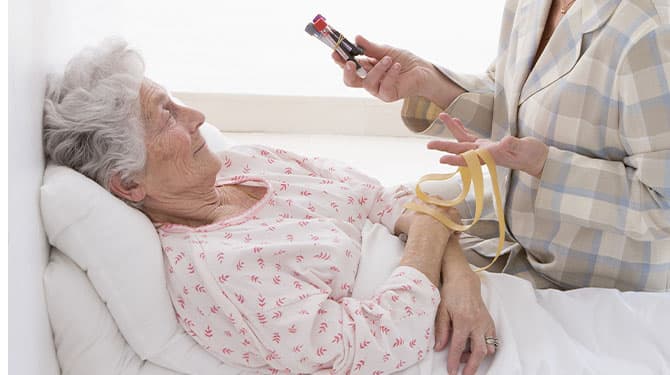
Residents of nursing homes, assisted living facilities, and long-term care communities require routine and specialty laboratory testing just as often as patients in other settings — sometimes more so, given the complexity of their medical conditions and the number of medications they manage. What they can't easily do is travel to a patient service center for a blood draw.
Mobile phlebotomy for nursing homes and care facilities solves this problem at scale. A certified phlebotomist comes to the facility, collects specimens from each resident on the collection schedule, and ensures that samples reach the processing laboratory with the documentation and cold-chain handling each test requires.
Why nursing home residents need on-site phlebotomy
The clinical case for on-site phlebotomy in long-term care is straightforward. Many nursing home residents have conditions — advanced dementia, severe mobility impairment, oxygen dependence, wound care needs — that make transport to an outpatient lab not just inconvenient but medically inadvisable. Every unnecessary transport represents infection exposure risk, fall risk, and exertion that can set a frail patient back.
Missed laboratory monitoring has real clinical consequences. A resident on warfarin (Coumadin) whose INR goes unchecked for weeks is at elevated risk for stroke or bleeding. A resident on lithium or another narrow-therapeutic-index medication whose drug level drifts outside range may develop toxicity before anyone realizes it. Thyroid function and metabolic panels that go uncollected delay the detection of conditions that are highly treatable when caught early.
On-site phlebotomy eliminates these gaps by making the collection come to the patient rather than the reverse.
How Speedy Sticks serves nursing home facilities
We work with nursing homes and care facilities in several ways depending on the facility's size and needs:
- Scheduled recurring rounds — a phlebotomist visits on a regular cadence (daily, weekly, or as scheduled) to collect standing orders for all residents due for labs, coordinating with nursing staff to ensure orders are current and residents are prepared
- Stat and urgent collection — when a provider orders urgent labs that can't wait for the next scheduled round, we dispatch a phlebotomist on an accelerated timeline
- Specialty draws — therapeutic phlebotomy for residents with hemochromatosis or polycythemia, PICC line draws where appropriate, pediatric-sensitive techniques for young residents in specialized facilities, and dementia-adapted collection protocols for cognitively impaired residents
- Multi-resident coordination — for facilities with many residents needing labs on the same day, we coordinate efficient room-to-room routing to minimize disruption to the facility's schedule and staff
Documentation and laboratory coordination
Nursing home laboratory workflows require careful documentation. Each specimen must be correctly labeled with resident identity information, matched to the active physician order, and processed through the correct laboratory — whether that's a reference lab like Quest Diagnostics or Labcorp, the facility's contracted lab, or a specialty laboratory for specific tests.
Our phlebotomists coordinate with facility nursing staff to confirm active orders before collection, document collection time and phlebotomist credentials on each requisition, and handle specimen packaging and transport logistics including temperature requirements. Results are routed back to the ordering provider through the established laboratory workflow.
Dementia-adapted collection in long-term care
Many nursing home residents have Alzheimer's disease or other forms of dementia that make the standard phlebotomy experience challenging. Our phlebotomists are trained to adapt their approach for cognitively impaired residents — using simple one-instruction-at-a-time communication, scheduling draws during the resident's most lucid window of the day, minimizing environmental disruption, and working in close coordination with facility staff who know the resident's preferences and triggers.
When a draw cannot be completed on the first attempt due to resident distress or medical factors, we document the attempt and coordinate with the facility and ordering provider on how to proceed rather than continuing against the resident's expressed resistance.
Partnering with Speedy Sticks for your facility
We support nursing homes ranging from small single-facility operations to multi-site groups across a region. To discuss recurring laboratory collection for your facility, contact our operations team to describe your resident census, collection frequency needs, laboratory relationships, and any specialty requirements.
Learn about our homebound blood draw service or read about dementia-adapted blood draws.
Common lab tests ordered in nursing home and long-term care settings
The laboratory workload in a skilled nursing facility is different from a general outpatient practice. Mobile phlebotomy services in LTC must be prepared to collect a predictable mix of routine and specialty specimens across a resident population with complex, often overlapping conditions.
Anticoagulation monitoring: Warfarin (Coumadin) requires regular INR monitoring — typically weekly during initiation and dose changes, and monthly during stable maintenance. A single missed collection can result in a therapeutic or supratherapeutic INR going undetected until a bleeding event or clot occurs. On-site phlebotomy eliminates the transport barrier that causes these gaps.
Narrow-therapeutic-index drug levels: Residents on digoxin, lithium, phenytoin (Dilantin), valproic acid, or cyclosporine require periodic drug-level monitoring. Lithium and digoxin in particular have narrow windows between therapeutic and toxic concentrations. Many nursing home residents have impaired kidney function that slows drug clearance, making level monitoring more critical — not less.
Metabolic and kidney function panels: CMP, BMP, and BUN/creatinine are ordered frequently for residents on ACE inhibitors, ARBs, diuretics, or any medication that affects electrolytes or kidney clearance. Hyperkalemia from ACE inhibitor use in a resident with declining kidney function is a preventable emergency when caught on routine labs.
Thyroid function (TSH): Hypothyroidism is common in elderly women and contributes to cognitive decline, depression, and weight changes that may otherwise be attributed to dementia. Annual monitoring is standard for residents on levothyroxine.
Nutritional markers: Albumin, prealbumin, CBC with differential (for anemia), vitamin B12, vitamin D, folate, and iron studies are commonly ordered to assess nutritional status and guide dietary and supplement interventions — particularly important for residents with pressure wounds, poor intake, or recent acute illness.
Wound and infection workup: Blood cultures, CBC with differential, CRP, and procalcitonin are ordered during acute infection workups. Mobile phlebotomy services must follow strict aseptic technique and understand the collection requirements for blood cultures (two-bottle sets, proper volume, timing relative to fever spikes).
Infection control considerations for on-site phlebotomy
Nursing homes host residents in various isolation categories — contact precautions for MRSA or C. difficile, droplet precautions for influenza, and airborne precautions for tuberculosis. Mobile phlebotomists entering these facilities must follow the facility's infection control protocols without exception.
What competent mobile phlebotomy services do in LTC settings:
- Review the isolation log before each visit to identify which residents require PPE beyond standard precautions
- Gown, glove, and mask appropriately for contact and droplet precautions before entering isolated rooms
- Follow proper doffing sequence after leaving an isolated room before entering another resident's space
- Never reuse or share supplies between residents — a separate tray setup for each room
- Dispose of sharps on-floor using the facility's sharps containers rather than transporting uncapped needles through common areas
When evaluating a mobile phlebotomy partner, ask specifically how phlebotomists handle isolation rooms. A provider who has not trained for LTC-specific infection control introduces risk to your most vulnerable residents.
Regulatory and billing considerations for facilities
CMS and survey implications: Centers for Medicare & Medicaid Services (CMS) guidance requires that laboratory services be provided in a manner that supports the medical needs of residents. Facilities that experience chronic delays in laboratory collection — due to transport challenges or staffing — may receive survey citations under the quality of care provisions. Documented, contracted on-site phlebotomy services support compliance.
Who pays for mobile phlebotomy in LTC:
- For residents under a Medicare Part A skilled nursing facility stay (the first 100 days post-hospitalization), the SNF is responsible for all ancillary services, including laboratory collection. The SNF may bill Medicare Part A as a bundled service and then contract with a mobile phlebotomy vendor directly.
- For residents on Medicare Part B (long-stay residents not in a covered SNF stay), laboratory services are billed separately. The collection fee may be billed by the mobile phlebotomy provider to Part B directly, or the resident may be responsible depending on the provider's enrollment status.
- Medicaid billing varies significantly by state. Most states cover lab collection as a Medicaid benefit; enrollment requirements for the phlebotomy provider differ.
Speedy Sticks works with facility billing coordinators to clarify the coverage pathway before services begin. Contact us to discuss the structure that works for your facility.
Sources and further reading
Blood Draws for Nursing Home and Homebound Patients
Speedy Sticks coordinates blood draws for nursing homes, memory care facilities, and homebound patients — certified phlebotomists who adapt their approach for older adults.
Book a visit →